Pages

Friday, October 26, 2012

Who Wronged This Wright?

I didn't think it was possible.

Granted, I'm just an amateur student of architecture myself, but I'm still dismayed when somebody says they've never heard of Frank Lloyd Wright.

Fallingwater, the Kaufmann country house at Mill Run, PA
Wright was one of America's greatest architects, and popularizer of the prairie style of housing design that has become ubiquitous across North America's suburbs.  About 500 of his commissions actually got built during both sides of the turn of the 20th Century, but he designed twice that many projects, some of which are just as famous as what got built.

His most renowned commission was Fallingwater at Mill Run, Pennsylvania.  To this day, his exquisite multi-level stone and concrete country house for the Kaufmann family, perched over a real waterfall amongst elegant trees and grand slabs of rocks, is considered one of the best - if not the best - piece of American design in our country's history.

Unfortunately, his talent was only outmatched by his ego, yet considering both of those, and aside from some stunning projects in suburban Los Angeles, the bulk of his work was built in relatively uncelebrated places.  Places like Oak Park, Illinois, one of Chicago's first suburbs.  Wisconsin.  And Arizona.

The House Scholars Forgot and the Family Sold

Ahh, yes, Arizona!  After spending years on the frigid prairie around Spring Green, Wisconsin, Wright relocated his design studio, which he called Taliesin, to the much warmer climes of Scottsdale, in Arizona's desert.  In suburban Phoenix.  Which became his base of operations from the 1930's until his death in 1959.

Despite - or more likely, because of - his famous career, Wright had a miserable family life.  He cheated on his wives countless times, seemed to father children left and right, and made little effort to hide any of it.  Yet one of those poor children, David, received a special gift from his father:  a custom-designed house near Camelback Mountain, surrounded by an orange grove.  David and his wife, Gladys, lived there for decades, with her surviving him and eventually passing away in 2008, at the age of 104.  Their heirs, three granddaughters, sold the house - a unique spiral of concrete and steel - for $2.8 million.

Turns out, the property is no longer surrounded by orange groves, but sprawling mansions and luxury condominiums, all relishing their rarefied air in the shadows of Phoenix's rustic Camelback centerpiece.  The Frank Lloyd Wright original may have been sold for three million based on the pedigree of its designer, but somehow, the house ended up being flipped - for much less money - to a couple of carpetbagging developers from Idaho.

Two guys who'd never heard of Frank Lloyd Wright.  And had no idea a place like Phoenix, Arizona was home to such an architectural treasure.

They bought the place with plans to tear it down, subdivide the lot, and construct two brand-new miniature estates in its place.  Apparently without any research into the history of the property.

Not that a cursory inquiry into the home's provenance would have yielded anything significant.  According to the New York Times, which has been faithfully following this developing story for the world's architecture community, not much is known about this house, even though it was built in 1952.  David and Gladys did not want the elder Wright's notoriety to infect their family's home life, so they never welcomed the type of academic study that has chronicled other Wright designs.  Basically, it had fallen off the radar of many Wright scholars.

But not completely off of everybody's radar!  When word got out that a vintage Wright project had slipped into the hands of indifferent developers, suddenly preservationists were coming out of the woodwork to save the place.

Past Perfect Preservation

The David and Gladys Wright Home in Phoenix, AZ
It's a clever gem of a house, with a circular ramp from the ground up to a second level, under which is tucked a carport.  It's been described as shaped like a desert rattlesnake coiled to strike, but in actuality, its form is far less menacing.  Gracious and warm, with a delightful garden in its center, David and Gladys' home features many of the personal touches Frank Lloyd himself was famous for designing, such as chairs, windows, and other fixtures and furnishings specifically original to this home, and still in remarkably good condition.

For better or worse, however, those Idaho developers only saw money to be made.  A funky old house with a floorplan too odd for conventional buyers, and lots of prime real estate begging to welcome yet more McMansions.  And that red glazed plaque by the front door?  Frank Lloyd Wright's iconic "logo," as it were?  So what?

Blame the developers for only having dollar signs in their eyes if you like, or blame the public school system in Meridian from which they graduated (they were friends from high school), but isn't it also curious that it took some out-of-state developers to light a fire under Arizona's preservationists?  According to the landmark preservation document slapped together in the city's recent efforts to stave off its demolition, the property is described as "the most significant work within the city of Phoenix by the most significant architect in American history."

If that's true, and it probably is, why did it take its imminent demise, four years after the death of its last original owner, before scholars, designers, preservationists, and critics rallied around its cause?

According to the Times, Arizona law is strong on property rights and weak on historic preservation.  Perhaps that reality plays some role in why Arizona's Wright aficionados are having to scramble with a demolition moratorium that will only last three years anyway.  But who dropped the ball when the elderly Mrs. David Wright finally passed?  In 2008?  When plenty of Arizona scholars should have been aware that a prized Wright design could be in peril?

Maybe the family should be blamed, since it doesn't seem as though they cared much about the home's heritage.  If the granddaughters simply needed the money, couldn't a trust have been formed to purchase the property from them and preserve it?  Many heirs sell the family homestead for a variety of reasons, but this wasn't just any old family homestead.  To a certain degree, as the historic preservation landmark request states, this house is a remarkable amenity for Phoenix, which as a relatively new city, boasts precious little historic architecture.

Money Hounds Save White Elephants

Granted, money doesn't flow amongst Phoenix society like it does in Chicago and New York, where historic preservation is a way of life, and plenty of deep-pocketed donors with ready access to cash gladly fund a variety of preservation efforts.  And architects, in general, aren't the most wealthy of professionals.  That $2.8 million is chump change to a New York hedge fund manager, but for an Arizona designer, it's likely several years' salary.

Perhaps this is typical of what happens in "fly-over country," where other deserving architectural gems fail to attract the attention of angel investors willing to fund a piece of American history for posterity's sake.  It's unlikely any other buildings of this home's stature have simply been bulldozed for lack of interest, but should these developers from Idaho be left holding the bag when they try to do it on a previously forgotten Wright house?  If this property wins historic preservation designation for even three years, that's three years that the developers won't be able to recoup any of their investment.  Even if they got a good price for it back when nobody else was watching, and even though they had no clue about its provenance.

To their credit, now that the Idaho developers have been educated on the home's value, they admit tearing it down doesn't make the most sense.

"Does the house deserve landmark status? Yes. This place needs to be preserved,” one of them conceded to the Times. “But when three Wright granddaughters sell it for $2.8 million, for me to carry the cross for Frank Lloyd Wright, that’s not fair.”

And that's true, isn't it?  Why should two developers from Idaho, even though they'd never heard of Frank Lloyd Wright until all this mess blew up in their faces, be stuck with the cost of something the Wright family and Phoenix preservationists either couldn't - or didn't want to - assume themselves?

Frankly, altruism can only go so far.  Sometimes lessons are most strongly learned from loss.  If Wright's family and his present-day admirers can't scrape together the money necessary to purchase this home and preserve it, and since the property was acquired fairly and squarely, why not let the ball bounce where it may?

Even if it's a wrecking ball?
_____

Thursday, October 18, 2012

When Waiting Wearies

Waiting.

Waiting, waiting... waiting.

It's what a lot of us seem to be doing a lot these days, isn't it?  Waiting.

I'm waiting for a writing job that will pay my bills.  Perhaps you're waiting for a job, too.  Employment is something for which many folks are waiting.  I just finished reading an article online about a run-down rust-belt town waiting for the "next big thing" to come along and revive their local economy and drive down their high unemployment rate.  Some experts say corporate America is waiting for this November's presidential election to be over before making long-term plans regarding investing in new products or new employees.

Waiting can be excruciatingly frustrating.  Thousands of New Yorkers were waiting on idle subway trains earlier this week, waiting for glitches to be exorcised from the MTA's byzantine switching systems.  If you've ever been at the mercy of public transit when things aren't working, you know how maddening it can be.  Maybe you wait in long lines of bumper-to-bumper traffic during your morning and evening commutes, day after day, mocking the word "rush" in rush hour.

We wait, and wait, and wait some more.  About the only thing for which we never have to wait is, well... waiting.

The difference between people who simply sit and wait, and people who keep busy while they're waiting, may actually provide the spark that ignites the "next big thing" our society seems to be waiting for economically, politically, and even emotionally.

I've been writing this blog, trying to ignite the interest of somebody who believes, as an editor of mine once told me, that I "deserve to be read."  The rust belt town languishing from the offshoring of its manufacturing economy is investing in higher education and new business incubators, hoping to somehow differentiate themselves from the plethora of small towns across America doing the same exact thing in the hopes of jump-starting their economies.

Maybe what you're waiting for has nothing to do with jobs, or getting to your job.  Maybe you're waiting for a report back from your doctor.  Maybe you're waiting to learn if you're going to be a parent, or a grandparent.   Maybe you're just waiting for your child's soccer practice to be over so you can have dinner.

Waiting By the Side of the Road

Then too, sometimes what we're waiting for, and what we get, are two different things.  We wait, thinking we know what we're waiting for, but do we?

About two thousand years ago, a blind beggar was confined to the roadside outside the gates of Jericho, an ancient city in what is now the political state of Israel.  This blind beggar's name was Bartimaeus, and although we don't know how old he was, or whether he'd been blind from birth or from some disease, we can easily assume most of Jericho's population probably knew him, or knew who he was.  They'd likely seen him there for years, begging and waiting.

Regardless of how long he hadn't been able to see, you can imagine that being blind for any length of time in that culture would have been sheer misery.  It's bad enough today in North America, where our culture is quite progressive in curing, treating, or providing assistance for people with vision problems.  Two thousand years ago, blindness was a virtual prison.

About all a blind person could do back then was take up a spot alongside a road and beg all day long, every day, and hope that enough sympathetic passers-by will toss enough money their way to buy a simple supper.

Waiting, all day.  Sometimes calling out when you hear people approaching, then slumping back against a wall or rock, and waiting some more.

Waiting, calling, begging.  But most likely, mostly waiting.  Waiting in utter darkness, even as you can feel the sun beating down on you.

Suddenly, Bartimaeus heard more than just the shuffling of passers-by.  There was a commotion, and he learned that Jesus of Nazareth was going to be passing right by his spot by the road!  Maybe Jesus would heal him!

He had to get Christ's attention.

So he hollered out, calling on Jesus to have mercy on him.  He made such a ruckus and racket, calling out so desperately, that people in the crowd, who had relegated him to the sidelines of life, sitting out of the way of normal people, told him to be quiet.

Yet undoubtedly, this was just such an opportunity for which Bartimaeus would likely have never before dreamed.  Maybe he'd spent his time waiting by the side of the road not only for enough money to make it through the day, but waiting for death itself.  The commotion he himself causes in this passage creates the impression that he'd immediately realized this might be his one chance in his entire life to be healed from blindness - and he was frantically hoping to seize the moment.

Christ is the Creator of Perfect Timing

Christ, of course, knew Bartimaeus was nearby on the roadside.  And he stopped.

The Son of God stopped, just like He does when each of His children call out to Him.  And Christ called Bartimaeus to Himself.

Quickly, the crowd changed its tune, turned to Bartimaeus, and said, "well, what do you know!  You've gotten His attention, and He wants to talk to you."

As you can imagine, Bartimaeus didn't need any more urging.  He jumped to his feet, likely needing to be steadied by people in the crowd who only moments before were telling him to shut up.  He threw off his cloak, perhaps so fully assured that Christ would heal him, he'd be able to retrieve it after his miracle, and he could see where it had fallen.

And sure enough, Christ performed his miracle, based on his blunt, honest, earnest faith.

I don't know about you, but I'm waiting for many things, not just a job.  You're probably waiting for many things, too.  Most of them aren't as dire as waiting for the remotest of chances to be healed from something as grave as blindness.  But yet the emotional, spiritual, and mental blindnesses with which we suffer may still be things we have to wait through until God's appointed time, when our waiting will finally be over.

Waiting can only be true agony when you don't trust the Person for Whom you're waiting.

May the Lord grant us the grace to wait as long as He would have us wait, and to wait with patience, hope, and even joy.

As the psalmist has so poignantly phrased it, wait on the Lord.  Be of good courage, and He shall strengthen your heart.  Wait, I say, on the Lord!
_____

Wednesday, September 26, 2012

Driving Change

Technology is driving some big changes.

Especially when it comes to how we drive.  Or... don't drive.

And change, as friends and regular readers of this blog know, isn't something I'm fond of.  Well, more accurately, it depends on what's changing, and the degree to which it's changing, as to whether I'll embrace it or not.

When it comes to the rapid developments in driverless cars, however, the automobile revolution some experts predict is imminent presents a mixed bag for me.  I can appreciate some of its major benefits, but I'm not sure those benefits can outweigh its major drawbacks.

This is so big, I'm also not sure it will happen as quickly as some people want it to.

Removing Drivers From Driving Has Its Advantages

Back when I was in my teens and twenties, I used to enjoy driving.  As I've gotten older, however, and the driving population has gotten younger and far more reckless, I now consider driving more of a necessary evil than a fun way to spend some time getting from Point A to Point B.  To many Americans, driving is more of a waste of time than a pleasurable experience.  To the extent that so many of us think we can multi-task behind the wheel, it makes sense to try and take operating the motor vehicle in which you're traveling out of that list of tasks.  Few people multi-task well, especially when driving.

The theory behind driverless cars is that once the driver is removed from the driving equation, automobiles will automatically become an incredibly safe mode of transportation.  With the key word being "automatically."  Technology continues to provide amazing advancements in a robot's ability to sense motion, speed, the proximity of other objects, and infinite adjustments to calculations monitoring all of these variables in real time.  If the basic premise of "autopilot" that airplanes have featured for decades can now be extrapolated to the comparatively lowly car, what's stopping us, except more technology?

In their push to accelerate development of the necessary technology, Nevada has already licensed driverless cars, and California did so this week.  Google is testing some prototypes, along with other entrepreneurs hoping to get in on the ground floor of what a lot of people hope is the next big thing in transportation logistics.

After all, it won't be just passenger cars that can use driverless technology.  Cargo vans and even 18-wheelers could theoretically deploy the same technology and remove the oft-maligned profession of truck driver from the employment pool.  Not to mention our roadways.

It has been suggested that individual vehicle ownership itself could become anachronistic, as this new breed of cars becomes less an item for personal consumption, and more a generic mode of conveyance.  Parking lots might become extinct, as people simply dial up a transportation pod from a local fleet, use it to get wherever they need to go, and when they disembark from that transportation pod, it becomes available for the next call.

Kind of like a driverless cab.

Perhaps the very components of cars that make them so heavy and dependent on fossil fuels would become obsolete, since each transportation pod, programmed as they'll be on the street grid, won't need crumple zones, bumpers, and reinforced doors.  Traffic accidents will evaporate, claim experts, saving thousands of lives a year, and preventing thousands more injuries.

Remember, with driverless cars, computers do all of the driving, making split-second accommodations for varying traffic conditions that could otherwise cause a real person to make mistakes behind the wheel.

Yes, we'd probably still have traffic jams during rush hour, but they likely won't be as severe, since computers would be monitoring traffic flow, and there'd be no accidents to cause the traffic jams to begin with.  There would be no fender-benders, since computers would keep safe distances from other vehicles.  Nor would there be rubberneckers, gawking at accidents from the opposite side of a freeway, because first, there'd be no wrecks, and second, computers don't gawk at the misfortune of others.  Computers don't get drunk, tired, or distracted, either.  Neither do they speed.

See how so much of our modern life in post-industrial America would change with driverless cars?  Probably no more car ads, since the cars would all perform basically the same.  It would be more like a bunch of enclosed golf carts, differentiated only by whatever bling with which an individual owner - if there are people who'd still want to own their own transportation pod - would want to customize it.  Hey, back when horse and buggies were a conventional mode of transport, there was little customization, so maybe what was old could become new again.

Many cities around the world today have implemented bike-share programs, where people can rent bicycles in different parts of the city, and ride them to their destination, where another bike rental facility would receive the bicycle, and another person can rent it for wherever they need to go.  If parking lots don't become extinct, they'll likely become centralized rental depots for these transportation pods, kinda like today's car rental lots at airports.

Switching Gears

Yes, it all sounds rather weird, and would take some getting used to, but the savings in lives alone represents a hard benefit to downplay, doesn't it?

With all of the efficiencies and safety improvements we'll likely achieve with driverless cars, however, I see some significant drawbacks.

First, what will Government Motors (er, I mean - General Motors), Ford, and the other legacy car manufacturers have to say about this transportation transformation?  It's unlikely that driverless cars will be able to retain the aura and intrigue of what's become a conventional aspect of car ownership - each model's driveability.  If it doesn't matter how quickly a car can accelerate or stop, or maneuver out of a dangerous situation, who's going to buy one simply for the hood ornament or nameplate?

The loss of the driving aesthetic is potentially the greatest liability for driverless cars, since by their very description, the reason most customers are willing to pay what they are for the cars they buy has to do with how they drive.  If it doesn't matter how they drive, or what kind of safety features they have, then car manufacturers will pretty much be trying to push those glorified golf carts.  After all, you can bet the government isn't going to be crazy about allowing driverless cars to travel very fast - they'll be more interested in the environmental value of reduced carbon emissions.

And speaking of speed, certain intangible conveniences will be lost with driverless cars.  How many people speed to make up for lost time?  In a driverless car, you can only go as fast as the government will physically let your car be programmed, and only on prescribed roadways.  If you're running late, you likely won't have time to program off-the-cuff shortcuts into your transportation pod's GPS.

Also, remember that the speed at which your car travels is also the speed at which every occupant in the car is traveling.  Therefore, just because you won't be driving, your car's computer will still need to compensate for the reaction time necessary in case it encounters, say, a dog running out into the street.  If you're working on your laptop computer or drinking a cup of hot coffee, and not paying particular attention to the roadway being navigated by your car, you could suffer injuries inside its passenger compartment if your car is traveling too fast for emergency maneuvers.

What else is there?  How about money, since many government entities count on speeding tickets for much-needed revenue.  Road construction costs would remain the same, while undoubtedly, new technology would have to be purchased by transportation departments to help manage computerized traffic flow.  Even though each transportation pod wouldn't need expensive safety features, somebody's going to have to pay for all of the new driverless technology, and you can bet its developers will be looking for a hefty ROI as well.  If the passenger car looses its allure as a commodity, who - or what government agency - will purchase them?

Then there are emergency vehicles, such as fire engines, police cars, and ambulances, who will still need to navigate the same streets as driverless cars, but at greater speeds, and likely with less flexibility in terms of inputting GPS coordinates for the latest crisis environment.  What about inclement weather?  Will driverless cars need to crawl at a snail's pace just because they detect water, ice, or snow on the road surface, or will they be able to adjust for varying conditions being experienced not only by your vehicle, but other vehicles concurrently traversing different patches of slush, mud, and other hazards just another lane away from you?

Indeed, the scenarios and complications that need to be worked out before driverless cars become commonplace seem far more numerous than the benefits of driverless cars.  It seems quite unlikely that I'll be having to face this drastic transportation - and cultural - revolution in my lifetime.  Maybe that's why I can look at the benefits of driverless cars with such surprising sanguinity.  I can appreciate the same things their ardent advocates appreciate, but I don't need to worry about having to fret through the details of making the switch myself.

Some people sometimes say change can't come soon enough.  In this case, change seems to be coming soon enough to suit my tastes!

That's the kind of change I like.
_____

Tuesday, September 25, 2012

Christ Got Into the Boat

22 Immediately Jesus made the disciples get into the boat and go on ahead of him to the other side, while he dismissed the crowd. 23 After he had dismissed them, he went up on a mountainside by himself to pray. When evening came, he was there alone, 24 but the boat was already a considerable distance from land, buffeted by the waves because the wind was against it. 25 During the fourth watch of the night Jesus went out to them, walking on the lake. 26 When the disciples saw him walking on the lake, they were terrified. "It's a ghost," they said, and cried out in fear. 27 But Jesus immediately said to them: "Take courage! It is I. Don't be afraid." 28 "Lord, if it's you," Peter replied, "tell me to come to you on the water." 29 "Come," he said. Then Peter got down out of the boat, walked on the water and came toward Jesus. 30 But when he saw the wind, he was afraid and, beginning to sink, cried out, "Lord, save me!" 31 Immediately Jesus reached out his hand and caught him. "You of little faith," he said, "why did you doubt?" 32 And when they climbed into the boat, the wind died down. 33 Then those who were in the boat worshiped him, saying, "Truly you are the Son of God."  Matthew 14:22-33


For the past two Sundays, my church's pastor has been preaching from Matthew 14 and the account of Christ and Peter walking on the water.

And while his sermons have explored lessons on how focusing on Christ can eliminate fear, and that we should worship Him for his wondrous acts on our behalf, some other elements of this famous event hit me this morning as I was pondering this same passage during my devotions.
  1. Jesus "made" the disciples get into the boat.  It's as if He wanted to get rid of them for a while, like parents telling their children to go play outside.  Why?
  2. Why?  So He could fellowship with His Father.  He went up on the mountain to talk with God, with Whom He shares a uniquely holy relationship as both God's Son, yet a fellow member of the Trinity.
  3. Christ stayed on the mountain with God for quite a while, likely enjoying their utterly profound interpersonal bonds; both paternal and spiritual.
  4. Meanwhile, what were His disciples doing?  They were out in a boat on the Sea of Galilee, likely chatting amongst themselves about any number of things, from the miracles they had just witnessed, to Christ's shunting them off into the boat so He could be alone, to the wind that was battering their craft with increasing strength.
The contrast is stunning, isn't it?  Christ, secluded on a mountaintop, in communion with the God of the universe, Who was also His real father.  On the other hand, there are His bumbling disciples, on a lake, in a boat, struggling to maintain course.

Christ Chooses To Be With Us Despite Ourselves

I don't know about you, but I'm not on the mountaintop with Christ and His Father.  I'm in the boat, anxious, along with His other disciples.  I'm trying to figure out from which direction the wind is coming, and fretting about being blown off-course.

Maybe you're up on the mountaintop with Christ, in a sublime fellowship with God that sets everything else around you into a confident perspective.  Enjoy it, because even Christ's time up there didn't last for long.

Eventually, Christ comes to His disciples in the boat, tossed about by the waves.  He walks on water, both literally, and perhaps even figuratively, since He'd just left the immediate presence of His Father, our God.  What a dose of reality that must have been for Jesus, having to leave the mountaintop - again, both literally and figuratively - and resume His association with such a rag-tag band of mortal followers.

No titans of industry, no heads of state, no engineering geniuses, no entertaining celebrities.  Christ's disciples were ordinary, politically disenfranchised, and of modest economic means.  It seems Peter was the only one to provide the entertainment, only whenever he did, it was entirely unintentional.

And probably only really funny to us, reading the Bible's accounts of his bumblings with the benefit of millennia of hindsight.

Speaking of entertainment, isn't it almost laughable for the disciples to initially wonder if the apparition they see on the water is a ghost?  Had the wind and choppy water made them that afraid?  They'd only been deprived of Christ's physical presence for perhaps a matter of hours, and after some pretty spectacular miracles, too.  It was so easy for them to forget that He had just fed thousands of people with five loaves and two fishes.  Why wouldn't he be able to walk on water?  The psalmists say that seas obey Him, right?  Yet short memories of Christ's power is so very typical of not just them, but us, too.

Isn't it?

Having Christ call out to reassure them, and having the mental picture of Peter - of course, it would be Peter - demand that Christ allow him to walk on water, too, can almost be anti-climactic.  So often, we mortals assume the climax of this story is Peter's walking on water.  But perhaps the climax actually is Christ getting in the boat with His followers.

Did He have to?  How much of His earthly ministry depended on the disciples?  None of it, right?  Christ could have accomplished His work on Earth in any number of ways that wouldn't have required what must have been an arduous, demanding, oftentimes thankless job of teaching - and re-teaching - an ad-hoc group of tax collectors and fishermen.  He'd just come from fellowshipping with His own father, and was likely forcefully reminded of what He was missing, working on Earth, instead of being with God in Heaven's glories.

Leaving Glory

Instead, He was climbing - literally and figuratively - back into that wooden boat, with that same group of forgetful, feeble, selfish, confused guys who mostly thought they were working for a new political kingdom for Israel.  It's like His incarnation all over again.

Christ got back in the boat with us.  But not to be "one of the guys."  He didn't get back in the boat to hone His street cred as a savior-type dude.  He got back in the boat, because as our Savior, He exudes love, and His disciples could do nothing else but immediately worship Him.

They didn't slap Him on the back and say, "boy, that was a cool trick!  How did You do that?"

They were transfixed in awe and wonder, and likely, a good deal of shame at their obvious lack of faith and incredibly short memories.

And they were also undoubtedly greatly relieved and happy that He was back with them.  Joyful, even.

Christ's love for them honored God, and modeled for both them then, and us today, one of the many reasons we have to worship Him.

He left God's glory and got in the boat with us.
_____

Thursday, September 20, 2012

Can Karma Be All About Looks?

I just saw my first Fisker.

A Fisker Karma.  Silver.  With a black glass roof lined with metallic circuitry.

This Karma Ain't No Chameleon

Fisker Karma is a brand-new hybrid luxury sedan that can get up to 52 mpg, despite its sprawling dimensions.  I saw my first Fisker today while gazing out a third-floor window in none other than Arlington, Texas, a city better known for sports and chain restaurants than exotic automobiles.


Who knows - the driver may have been a sports celebrity.  He was a fairly short, muscular white guy with a thick head of black hair.  I watched as he pulled into a bank's narrow parking lot, and found his Fisker was too wide to fit between a poorly-parked black pickup truck and an idling armored truck.  The driver waited for a while, and then got out of his car (that's how I know how tall he was), motioning for the driver of the armored truck to move up just a few feet.  But the driver in his burly rig just stared at him.

Was that karma, maybe?

Finally, the Fisker guy got back into his swanky ride, backed away, and drove off.  Since I was up high, I could see him soon coming around the back way into the bank's drive-through area.

Maybe he had to make a deposit to cover his first month's payment.


We have a hazy sky here in north Texas this afternoon, but still plenty of sun to keep the solar cells built into the Fisker's roof drinking up the energy rays.  That's why, from above, the car's roof looks like a sleek circuit board hovering over the passenger compartment.

Developed for around $1 billion by a team of automotive and ecological engineers headed by Danish designer Henrik Fisker, the Karma represents the leading edge of a brave new world of ultra-luxury low-emissions vehicles.  At least, if you view hybrids and all-electric cars apart from the coal and gas-powered factories powering the massive electric plants essential for this new automotive technology.  We may all be fooling ourselves that "green" cars are really helping to save our planet, considering that somewhere along the way, fossil fuels still play a huge role in how they operate.  But if the ride into our environmental fantasy is going to be in cars like the Fisker, we'll at least be stylin' our way around the proverbial bush.

Immediately, looking out the window from my perch, I could tell this was a different car, even before I could recall it's name.  Fisker is brand-new to the automotive world, completely separate from the Big Three and any foreign legacy car makers, except for its GM-produced engines that power each car's generator.  Its fluid, sexy styling invokes flashbacks to the Jaguars of old, and comparisons to today's Aston Martin Rapide - at twice the price - or maybe a late-model Maserati Quattroporte.  In any event, these are all relatively rare cars, even in the exotic environs of haughty north Dallas, where elite nameplates seem to breed in valet parking lots.

Earlier today, I was chided by a reader of an essay of mine about Mitt Romney and his $250 million fortune.  My reader thought I sounded jealous of Romney's wealth, which seems to be the typical reaction these days from conservatives who think pointing out millions of dollars in assets is akin to class warfare.

Chill, people!  Who's the one who preaches on this blog that it's the love of money that's the root of evil, not money itself?  Like many things, money is relative, and I only wish I had a relative with lots of it!  Okay, bad jokes aside, as long as anybody with money - whether it be somebody working a minimum-wage job or somebody with Warren Buffett wealth - tithes the portion of that money God directs them to, how they spend what's left over is more a matter of being responsible to God than being restricted by Him.

And "being responsible" is laden with cultural variables.

In the United States, spending $25,000 for an automobile is considered relatively normal and prudent, and hardly extravagant.  But in India or Bangladesh, spending that amount of money would be seen as absurd by most of the populace that barely earns that amount in their entire lifetime.  Meanwhile, spending $100,000 on a car like the Fisker is low-balling it, at least in the orbits of New York City's hedge fund titans, or the technology wonks out in Silicon Valley.

What Effect is This Cause Having?

Maybe it's because I've always had a weakness for cars, but if somebody can honestly afford to buy something like the Fisker, I say "congratulations, and enjoy it!"  Having said that, if I personally had the money to buy one, I'm not sure I would.  But not directly because of the cost.  Being the cynic I tend to be, I'd be anxious about some crazy uninsured driver hitting it.  And speaking of valet parking, I don't even let valet employees park my humble Honda Accord anymore, after one of them scuffed the bumper of my last Honda in the back lot of a Dallas restaurant.

It's also valid to point out that cars like the Fisker have a history of introducing new features and engineering to the broader, mass-consumption market.  I'm not crazy about professional car racing, but I can't deny that many of the safety standards and equipment we drivers and passengers enjoy today have come from NASCAR and other real-world racing venues.  Who knows yet the amount of technology Fisker and other new hybrid car manufacturers are pioneering that could make ordinary cars more environmentally-friendly in the future?  Indeed, a lot is riding on cars like Fisker's in more ways that one.  The fight over hybrid technology is so fierce these days, one of Fisker's competitors, Tesla, alleged in a lawsuit that Fisker had stolen some of its secrets.

As new as this technology may be, however, at least one part of the Fisker story seems to smell of the same old bad politics that have corrupted other environmental projects.  Fisker won half a billion dollars in guaranteed loans from our federal government, like the now-defunct Solyndra did.  Fisker also received $193 million in taxpayer-funded incentives to provide "green" jobs, even though the Obama administration knew Fisker is building these Karmas in Finland, of all places.  A mothballed GM plant Fisker purchased at a government fire sale will ostensibly be used for future cars in Fisker's pipeline.

That is, if Fisker can hold out that long.  Within weeks of its debut last fall, Fisker had to issue a recall, and has issued two more since then.  At least one fire has been definitively linked with their vehicles, and another fire may have been.  Such numbers wouldn't mean much for a mass-market vehicle, but Fisker has only sold a few thousand of their Karmas so far.

Some people with $100,000 to spend on a vehicle might let the car's incredible looks overrule a more pedestrian logic, and indulge themselves with one.  However, if you've earned that money yourself, you're probably also smart enough to consider your other, more time-tested options in this price class.

I spotted that gorgeous Fisker right away out of a parking lot full of cars, and a four-lane avenue teeming with traffic.

Maybe that kind of attention is still worth it to the guy who couldn't even get an armored truck to move a few feet out of his way.
_____

Wednesday, September 19, 2012

What Might They Say About You?

Some friends of mine who live in Europe recently told me a story.

They once shared a meal with some friends of theirs:  the husband a Frenchman, the wife a product of the former East Germany when it was under communist rule.

The wife who'd grown up in East Germany recounted how several years ago, her mother, who still lives in what's now a united Germany, received something completely unfamiliar to us Westerners.  She was given the file kept on her by the Staatssicherheit, or Stasi, which was East Germany's secret police.  While she was growing up, the wife knew her family was under suspicion because they would receive packages of things as harmless as denim jeans from family members living in the democratic, capitalistic west.  Such deliveries were major red flags for government agents trying to repress its citizenry.

Who knew blue jeans were subversive?

To try and avoid any further trouble with the Stasi, the wife's family stopped going to church, a custom widely known to invite friction with East Germany's government-sanctioned thugs.  After all, they couldn't really communicate to their free relatives how even something as ubiquitous as jeans could jeopardize their safety under communist rule.  At least, they rationalized, they could try to reduce their visibility by dropping church attendance from their list of activities which would be considered objectionable.

It doesn't seem the family was ever really harassed by the Stasi, but in the file this family's matriarch received after the Berlin Wall's fall, it wasn't for lack of evidence.  Turns out, close acquaintances, co-workers, and neighbors had all turned in the family to the Stasi for various things.  As you can imagine, the family was shocked more by the familiar names they saw in the file, not particularly what activities and habits those back-stabbers shared with the Stasi.

Apparently, too, this family had never thought to report these same friends to the secret police.

It has been estimated that approximately one in 63 East Germans collaborated with the Stasi, which is one of history's most impressive records of manipulation by a nation's secret police.  During its reign, the Staatssicherheit employed over a quarter-million people in various capacities; one soccer club alone had 18 agents.

In 1992, after German unification, the security organization's files were opened to the public for the first time.  As government researchers, ordinary citizens, and journalists went on the hunt for Stasi criminals, they soon discovered that much of the most incriminating evidence necessary to produce convictions in a court of law had been shredded or otherwise destroyed.  Indeed, the process for literally piecing together these paper trails - estimated at 45 million documents - has been arduous and time-consuming.  So far, only two former Stasi officers have been convicted of any crime from their years of torturing suspects, covering up state accidents, executing dissidents, and whatever else secret police officers do in the line of nefarious duty.

We take for granted the fact that here in the United States, stuff like this is something we hardly ever need to think about.  But do you know at least 63 people?  How many Facebook friends do you have?  How many people work for your employer?  How many people live in your apartment building, or in your suburban neighborhood?

In East Germany, remember, at least one in 63 people would be spying on you!

Here's another question:  If our CIA was recruiting informants to turn in evangelical Christians, believers in Christ whose primary allegiance was to God, not our president or any particular political party, who might turn you in?

You may be familiar with the time-worn question, "if you were on trial for your faith, would there be enough evidence to convict you?"  In a way, though, that's a fairly benign question, isn't it?  In a way, the personal nature of your faith is removed from how your faith may or may not impact the lives of people around you.

But what about those people around you; the people you know, with whom you work and associate?  The people who live next-door to you?  What might they say about you and how you live your faith?

What might a secret police organization's dossier on you look like?
_____

Friday, September 7, 2012

Long Life's Dear Cost

Living a long life used to be a good thing.

And if you're healthy, right up to the end, it may still be.

But for an increasing number of Americans, old age is not the good thing we've been led to believe.  The Lord has blessed our doctors, scientists, and other medical experts with incredible insight into how the bodies He created function, and that insight has led to some amazing advancements in healthcare, which have helped to lengthen lifespans.

Long life, remember, used to be considered a good thing worth striving towards.

In Biblical times, long life wasn't 80 years, or 100, but several hundred years.  We still don't know how the same human bones and flesh they had back then could last so much longer than ours does today.  Or, for that matter, what the quality of life was for those folks when they hit the 300-year mark.  Survival then was much tougher than it is today, which makes one wonder whether back-breaking labor might actually better for us than sitting at computer screens all day long.

We've just finished the last of our national political conventions, and today, the race for President of the United States goes into overdrive.  One of the key topics up for debate centers on how our country plans to care for its rapidly-aging population, including ideas for revising Medicare and, even more importantly, Medicaid.  Medicaid, after all, is what many middle-class families currently rely upon to fund the oftentimes exorbitant costs of long-term care for their loved ones.

Whether you're for vouchers, reducing the role of the federal government in healthcare generally and elder care specifically, or increasing Washington's role in determining and allocating funds for such care, we need to remember that funding elder care is not an abstract problem.  It's happening now.  Baby boomers pose a significant threat to the financial integrity of American families, charities, and the government, from the local to the state and federal levels.  And care isn't getting any cheaper.

Who Can Save Enough to Pay for Long Term Care?

It may be easy for all of the young fresh faces and voices of America's contemporary media, including blogs and political action groups, to view elder care as a cost-savings opportunity.  Letting policy shapers speak from lack of experience has become a dangerous trend in our country.  Speaking as a member of a family that has already begun the slow, expensive process of long-term elder care, however, I see this issue differently.  The loved ones in my family who need specialized attention have worked their entire lives in honorable yet modestly-paying jobs.  The kind of jobs most people have that, although ordinary, helped them afford decent homes and a few luxuries.  They've retired mortgage-free and credit-card-debt-free.  With savings.  So why should they worry about paying for their own care, right?

Sure, some right-wing Republicans might grouse that my family's loved ones should have striven to become independently wealthy, so they would know they could afford any healthcare contingency.  Meanwhile, any serious student of economics knows that not everybody can be a One Percenter.  Or even a Twenty Percenter.  My family's loved ones played the career and personal finance games as well as many other Americans have been able to.  Along the way, however, the retirement goalposts got moved.  And even if they'd earned twice what they did during their careers, it wouldn't be enough to pay for modern long-term care.

Hopefully, most rational conservatives can agree with many rational liberals, and recognize that personally funding retirement care these days requires much more than conventional savings and healthcare insurance, and experts differ as to whether long-term-care insurance is worth its steep cost.  Double the quandary when both spouses live into ripe old age.  Stories about running out of money, particularly because we're living longer than past generations, are incredibly frequent.  Even most long-term-care insurance policies cover only three years of care, while patients may live much longer.  Only an ignorant person would claim that any American worth their citizenship should be able to save up the money they'll need to pay for their own elder care, or hope three year's worth of expensive insurance provides enough protection.

Indeed, if there's one great equalizer in American society, it's elder care, because even if you've earned hundreds of thousands of dollars in retirement assets, you can burn through it quickly if you're not healthy.  And it strikes me as being a bit hypocritical of politicians - of all people - to be dictating how and what types of care should or shouldn't be funded anyway.  After all, many of them benefit from a federal healthcare program the rest of us Americans can only dream about.

Being Responsible for What God Expects of Us

People of faith, particularly those on the far-right side of the aisle who normally eschew anything that drains taxpayer dollars, need to remember that the Bible is explicit and repetitive on our mandate to care for the widows and needy among us.

If that means cutting back in other programs so that we can honor our elders by paying for the care they require, shouldn't we?

Of course, if that means cutting waste in the elder care programs we already have, shouldn't we?

Should it mean that family members currently working and trying to pay for their own retirement be forced to quit their jobs to perform the care for which our politicians don't want to pay?

Should it mean our pharmaceutical industry gets to set their prices for medications required to sustain life?  Or that nursing care providers and healthcare plan administrators get to inflate the costs of elder care by setting their own payment guidelines?

Where should the line be drawn between profit motive and pure greed when it comes to elder care?

Where should the line be drawn between our personal preference for low taxes and our ability to help out our fellow families grappling with elder care costs?  Granted, having the federal government administer elder care may not be the best approach.  The rules government bureaucrats and politicians concoct - particularly at the federal level - have a bad history of being woefully counterproductive.  Right now, Medicaid is run by individual states, and paid for by each state with matching funds from the federal government.  Technically, states can opt out of Medicaid, since their participation is voluntary.  So far, however, even though some states call their Medicaid program by a different name, all fifty states participate.

President Obama would like to expand Medicaid by broadening patient eligibility standards.  He says Obamacare will provide states more federal funds, but states will have to contribute more themselves, too, causing some to balk.  After all, whether we're talking state or federal funds, it's all still taxpayer dollars, so Obamacare doesn't really appear to be solving anything in terms of Medicaid.  Subtly expanding federal control over what has traditionally been a state-run program - which is what increasing federal participation would effectively do - doesn't sit well with conservatives, either.

Don't forget that Medicaid doesn't just pay for elder care.  It, along with Medicare, pays for a variety of healthcare costs for a variety of segments of our population.  When it comes to paying for elder care, however, it's usually Medicaid that taxpayers rely upon to cover the gaping cost gaps.  Unless somebody can come up with a better idea.

You've Aged Just Reading This

Fortunately, the recent trend towards home health care is helping to reduce some costs, and fast-paced advancements in the treatment of cancers and dementia may help provide cures to help senior citizens lead less dependent retirements.  But it's all still expensive.

A lot may hinge on what happens to Obamacare after this November's election.  Right now, depending on who you talk to, Obamacare is either lowering costs, or simply reducing the number of allowable medical procedures.  It's very difficult to parse the hype and rhetoric from reality.  Considering the resources required to provide the care you would expect for yourself or your parents, however, can we afford to spurn greater federal involvement in elder care?  If states opt out and lose federal funds, can our churches and community charities keep up with the growing demand?  Would you want your family to be one of the ones to find out?

Not that the government is the only hope for elder care.  But how realistic are we being by playing political gamesmanship with the needs of our aging population?  After all, even if we find ways to better manage elder care, and I hope we do, the demand for it won't go away.  None of us are getting any younger.

And we can't all hope to be the exception, and either earn enough or stay healthy enough to avoid the elder care cost crisis.

One of the blessings God offers His people in the Bible is long life.

How much of a blessing might long life really be?
_____

Tuesday, August 14, 2012

Maybe Taxpayers Can Save Art From Itself

Should taxpayers help fund the arts?

I used to think so, since in our increasingly casual society, the rigors and disciplines of art appreciation have gone into free-fall.  Despite the fact that cultural events help broaden the mind and speak to extraordinary beauty and creativity, pop culture teaches that if it isn't loud, obnoxious, transient, titillating, or easily-understood, it's not worth the money.  If the general public doesn't want to shell out the bucks to fund culture, is that a good enough reason to let the arts die?  

Where a community's taxpayers choose to put their money says a lot about their aspirations, their values, and their understanding of how humanity works.  Leverage a surcharge on sales taxes to fund football stadiums for millionaires to play in, and you see one scenario of a community's values.  Take a fraction of taxpayer funds to underwrite a modestly successful symphony, and you see one scenario of another community's values.  If your community has the will and resources to do both with tax dollars, there's yet another scenario of that community's values.

If taxpayers individually don't care about the arts, maybe collectively, they can still keep them around for those who do.

Taxpayers as Arts Patrons

But over the past few years, America's cultural scene - particularly in classical music - has been slowly shrinking past the break-even level in many cities across the country.  Sure, classical music has been cursed with declining popularity for decades, but in many of the communities that had been able to cobble together a budget for their orchestra, philharmonic, or symphony, economic fortunes have waned, along with populations.  And one by one, classical music organizations have been closing up shop.

Inevitably, before the last encore, arts patrons have tried to rally their communities for one last push to increase municipal arts funding.  But those communities have either decided the money isn't there even if they wanted to divert it to the arts, or they just didn't have the political will.  It's hard to argue for something that the vast majority of taxpayers don't want.

Which is one of the reasons I've changed my mind about taxpayer funding for the arts.  Yes, I still believe a thriving cultural scene provides an attractive resource that helps sell the community as a place with a high quality of life.  All the things arts boosters say about the arts still ring true:  corporate relocations tend to go where the arts are present; and our burgeoning "creative class" tends to cluster in places where the arts are well-funded.  The arts also provide a wide range of eclectic jobs that don't pay much, but help fill in some of the nooks and crannies of a city's skills set.

If we're going to get serious about our government budgets, however, and reform tax codes to benefit our economy, few sacred cows should remain.  Therefore, even though I'm a strong supporter of the arts in general and classical music in particular, I've come to the realization that I cannot expect my fellow taxpayers to help foot the bill for something they simply don't want.  Even if they don't recognize the inherent value in the arts.

When my city, Arlington, Texas, voted to raise the sales tax to help fund part of the new Dallas Cowboys' stadium here in town, I grudgingly voted in support of the proposal.  Not because I enjoy football, or because I looked forward to having a bunch of drunken louts trying to plow through our city streets after games trying to find their way home.  I simply couldn't avoid the economic benefit such a facility would bring to our community.  Some people groused that billionaires like the Cowboys' owner, Jerry Jones, had no business asking taxpayers to fund his enterprise, which is 100% true, but if Arlington didn't cough up the sales tax receipts, some other city would have.  That funding scam is bigger than us Arlington voters.

Behold What Oil Money Can Buy

According to its city's slogan, the west begins just to the west of Arlington in Fort Worth, that fabled cattle and oil town.  "Fut Wuth," or "Far Warth" as the natives say it in either their southern drawl or western brogue, has evolved from a raucous, brothel-strewn cowboy drinkin' town - whose downtown used to be called "Hell's half acre" - into a sophisticated sprawl of glassy office towers, wide boulevards, genteel neighborhoods, and some of the world's best art and architecture.  Most of the city's modern transformation has been paid for by generations of beef, oil, leatherwear, aviation, and even technology money.  The Amon Carter, Sid Richardson, Science and History, Kimbel, and Modern Art museums are known around the world.  Casa Manana attracts famous entertainers from New York and Hollywood.  Downtown's angelic Bass Hall hosts a decent symphony, even if it's not as famous as Dallas', just 30 minutes down the freeway.  Eminent classical pianist Van Cliburn retired to Fort Worth, where his quadrennial piano competition is considered the most elite of its kind on the planet.  Indeed, few cities of any size can boast a similar cultural pedigree.

Recent budget talks have the city gutting its percentage of funding to Fort Worth's prized cultural scene, however, and some arts patrons have gotten all up in arms.  Fort Worth has been cutting its spending on the arts for years, but with this new reduction, they might as well not be giving anything.

And maybe that's just as well.

If you don't live around these parts, you might not realize that most of our cultural icons are named as legacies for prominent Fort Worth families, such as the Carters, Richardsons, Kimbels, Basses, and so forth.  Plenty of heirs to these names exist with their family fortunes and then some.  I doubt that many of these people would welcome their family's name falling into disrepute, were their artistic endeavors to go underfunded.  It was self-aggrandizement that got these facilities built, and it will likely be self-aggrandizement that will keep their budgets afloat.  Isn't that part of how capitalism works?  Especially the tax write-off part every April 15?

The symphony, of course, is a little different, since such ventures employ a considerable number of people, and playing to a half-empty concert hall is far more discouraging - and harder to hide - than having half-empty galleries in a museum.  It's been commented by many classical musicians that here in north Texas, we have an extraordinarily rare number of symphonies and orchestras - up to five, depending on your artistic standards.  I certainly don't wish ill of any of them, but just as we have a number orchestras, we also are blessed in north Texas by many wealthy people who should be able to afford to step into the funding breach were tax dollars removed from the equation.

Not that I'm heaping all the responsibility for saving the arts on the backs of the wealthy, even though, "to whom much is given, much is required."  I'm well aware that money can't buy good taste, or an appreciation for beautiful music and good art.  So expecting the rich to bail out the arts might enable some woefully unqualified people to begin dictating artistic goals just because they're signing the checks.

How would that help anything?

At some point, then, more middle-and lower-income people need to be brought back into the art-appreciation fold.  More people buying more tickets will be one of the most sustainable and efficient ways to fund the arts, right?  But how do we do that?  Many arts organizations are already bending over backwards trying to attract more patrons of any economic level.

Is Pleasing the Public Bad for Art?

One solution I'd respectfully suggest is that we get back to the basics regarding what art is.  And this is the second reason I support the withdrawal of public funds from the arts.  Maybe a certain amount of good old American consumer economics is in order to help save our cultural jewels.  For example, some of the classical music I've heard at our local symphony halls really isn't all that interesting, and I say that as  a person who likes classical music.  If I don't care for it, how much do you think average music consumers would pay to hear it?

Probably not anything, right?  So how much of a cultural shell might our tax dollars be disguising?

I realize that within the arts community, playing pieces of music that aren't necessary popular increases the professional credibility of musicians and orchestras.  But how much ego should you let get in the way of communicating timeless music to audiences?  I recall attending a pipe organ competition at Dallas' Meyerson Symphony Center, and the music on the program was so awful, we audience members were literally being forced out of the concert hall in droves.  The next day, organizers of the competition dismissively defended their program as obviously too avant garde for Dallas - which, considering their attitude, said more about them than us.  If making a pipe organ shriek and blast like a malfunctioning ship's horn is considered good art, then you're the one with the problem, buddy.  Not those of us expecting to hear beautiful music.

Just as classical music that's considered "modern" is one thing, so is modern art.  Maybe I've already told you about another installation at the Modern Art museum that consisted of a white fluorescent light bulb.

Yup.

That's it - a fluorescent light bulb, turned on, and bolted at an angle on the wall.  Shoot fire - if that's art, let's go to Home Depot - you'll go nuts!

If you weren't nuts already, that is:  thinking a light bulb mounted on a wall suffices as art.

While I can see the statement the artist is attempting to make, it's hardly worth the price of a $7 ticket, is it?  I mean, can you imagine Home Depot charging you money just to look at their inventory?  It's this kind of - frankly - stupid claim of artistic integrity that has contributed to the general public's dismissive attitude about art.  Granted, just as many people have a hard time appreciating Monet, so the general public's apathy is not entirely modern art's fault.  Some people just don't know what they see, which is what some of you artsy types may be thinking about me and my rant about light bulbs.

Will getting back to genuinely artistic art be the cure-all for all of the budget woes in our cultural districts?  Probably not entirely, no.  But does expecting taxpayers to continue helping out with the bills make any more sense than some of this stuff we're supposed to call artwork?  If tax dollars are removed from arts funding, how much will arts organizations be forced to return to the beauty most of us know can be found in more mainstream expressions of art?  After all, is art many people can appreciate necessarily worse than art most of us think is ugly?  To the extent that the general public disregards the arts, how much have they been pushed from the scene by arts snobs who still expect funding from the very people at which they sneer?

You might be surprised to hear me admit that despite some ludicrous examples, there are several genuinely clever and compelling pieces of art in Fort Worth's Modern.  So I visit from time to time, checking out what have become something like old friends.  On one of my visits, however, while walking through a gallery lined with ghastly paint dribbles evocative of Jackson Pollock in miniature, I overheard two ladies, perplexed, conversing with a young docent.

"Who decides this stuff is art?" one of the ladies asked with complete sincerity.

It took the docent so long to come up with some sort of reply, I was already in the next gallery before the reply came.

But I felt like stopping and saying, "the people gullible enough to pay for it."
_____

Thursday, July 19, 2012

Just a Little Bit More Than the Law Will Allow


And then there's this:

Last week, a state trooper in Bradley, Maine, pulled over Rosco P. Coltrane, fabled sheriff of television's Hazzard County.

Okay, so the Maine state trooper is real, but the driver he pulled over was a Maine civilian who collects memorabilia from the classic 1980's TV show, the Dukes of Hazzard.  It wasn't the driver who was committing an offense, but the car he was driving - a white, mint-condition 1978 Dodge Monaco (pictured above), complete with sheriff decals, emergency lights, and a siren.

Oh yeah - and a stuffed animal named "Flash," after Coltrane's languid basset hound, in the back seat.

Once the owner of the replica cruiser explained his vehicle to the mystified trooper, named Michael Johnston, Trooper Johnston let him off with a warning to have its emergency lights and siren disconnected.  Even though everybody else in town already knows it's just a show car.

Now, if like Trooper Johnston, you're too young to recognize the '78 Dodge from its days as a ubiquitous police cruiser, allow me to remind you about the Dukes of Hazzard.  I've commented before on that true period piece - it aired during the same era as the prime time soap opera, Dallas.  Poorly written, horribly directed, and badly acted, Dukes was even worse than the artistically-challenged Dallas, but just as wildly popular.

(What does it say about the 1980's that these were two of its signature TV shows?)

There wasn't much cheatin', back-stabbin', and cutthroat oil dealin' in Dukes, but it had what most any other TV show needs to succeed:  goofy comedy, a flashy car (in the form of an orange Dodge Charger with the Confederate Flag painted on its roof), good guys always comin' out on top, and a gorgeous girl.

Catherine Bach played Daisy Duke, the gorgeous girl, and her impossibly short denim shorts - not exactly a new fashion idea - soon were called "Daisy Dukes" because, well, she embodied them so well.

John Schneider and Tom Wopat played the mischievous Duke brothers, Bo and Luke; two guys who never seemed to have regular work, unless you count always running afoul of the county's white-suited villain, Boss Hog. Boss Hog, played by Sorrell Booke, used his feeble-brained sheriff, Coltrane, to protect all of his various nefarious business schemes.  The Duke brothers' iconic orange Charger, christened the General Lee, was just as famous as any of the show's human actors, and exaggerated car chases between the General Lee and Sheriff Coltrane's cruiser - and sometimes, Boss Hog's old white Cadillac convertible - usually ate up more air time than the show's dialog did.

Backing up that cast was the wizened, grizzled Uncle Jesse; the greasy mechanic, Cooter, who usually ended up having to get Bo and Luke out of trouble; and the docile, bashful Deputy Strate, who for southern law enforcement agencies, made about as cringe-worthy a reincarnation of Mayberry's ineffective Barney Fife as any of the show's other blatant stereotypes.

Oh yes - and Flash, the sad-eyed old hound who'd probably seen so many of his owner's hijinks go awry, nothing could perturb him anymore.

Really, it shouldn't have been as popular as it was, but it was.  And its popularity came from its uncanny ability to portray a simpler place and time in American folklore.  Something not quite turn-of-the-century Old South provincialism, but not quite modern-day suburbs-invading-the-countryside, either.  Good and evil were easier to spot and deal with, with good ol' common sense and family values ruling the day.

Of course, it's rather ironic that a cop in rural Maine would pull over a benign, unofficial cop car outfitted as a replica of southern sheriff Coltrane's veee-hickle, as Coltrane would say.  Geographically speaking, Maine is about as far north from the South as you can get, but in terms of its slower pace of life, both New England and the Deep South have a lot in common.  Switch the accents, and take out all of the wealthy Boomers who've recently retired to Maine, and Dukes could have been filmed in the Pine Tree State.  For something like a state trooper's concern over a replica squad car to make news speaks to the down-home nature of Maine, and probably would have made news down South if it happened there, too.  Here in urban north Texas, this wouldn't be news, because most of our local police departments are too busy fighting real crime.

Indeed, word is beginning to spread here in Arlington, between Fort Worth and Dallas, that a new urban gang may be trying to establish itself in the northern part of town.  Just today, our neighborhood crime watch sent out an e-mail with the link to a video on YouTube showing a group of about twenty gangsta-type wannabies in a local park rapping with vulgarities and sinister swagger about drugs and general mayhem.  This same group is suspected of vandalizing another city park and bullying groups that had legitimately reserved pavilions at local parks.  Arlington never used to have a real crime problem, but it has now for years, and the small-town feel that was still here when my family moved down in the late 1970's is long gone.

It's this kind of stuff that is unsettling and even threatening to people like my neighbors and me, since we live in an established neighborhood, and are surrounded by dilapidated apartments like the ones featured in the video.  People who used to leave their front doors unlocked during the day now have security alarms, motion sensors, and closed-circuit cameras wired all over their properties.  If this new gang proves to be a genuine threat, what's next?

If only we had the crime problems like Trooper Johnston - shucks, and even Sheriff Coltrane - have, then everyday life would be a lot less stressful.

Oh well, at least in Bradley, Maine, traffic is tame enough for this replica cruiser's owner to drive his classics around town without fear damaging them - or having them get stolen.  Here in north Texas, meanwhile, driving is done pretty much the same way Bo and Luke careened their General Lee through those dirt roads and ramps on the studio lot.

Yee-haw.
_____

Tuesday, July 10, 2012

Saving Climbers from Themselves

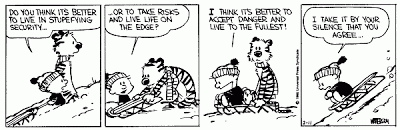
Calvin and Hobbes by Bill Waterson, February 11, 1986


Climbing.

Ascending, reaching, hoping, enduring, achieving.  Being tenacious, always evaluating the terrain, looking towards the summit.

It's a thrill, a rush, a tangible accomplishment.  Adrenaline.  Bravado.  Something weaker people with fainter hearts and flabbier limbs either can't do, or are too lazy to try.

It's one thing to put on some hiking boots, grab some bottled water, and saunter up a pleasant hillside to take in the vista, or trek along a hilly forest path underneath the graceful, broad canopy of weathered trees.

But either our news media is getting more fascinated with the stories of botched rescues of climbers, or more and more Americans are woefully underestimating their mountain climbing capabilities.

Nick Hall, a native of Maine and professional search-and-rescue ranger, died June 21 while trying to help four climbers from Texas on Washington state's Mount Rainier.

Aaron Beesley, another professional rescuer, fell 90 feet to his death on Utah's Mount Olympus this past Saturday while trying to rescue two teenaged hikers.

Tony Stanley, a California Highway Patrol officer, was injured last Thursday when the rotor blades of his rescue helicopter clipped him as he attempted to reach a stranded hiker - who was a doctor.  The doctor, who had suffered a relatively minor injury by comparison, which had contributed to his need for rescue, ended up saving his rescuer's life.

Granted, considering the number of people who go mountain climbing for recreation every day all over the United States, these incidents could be considered statistically irrelevant.  And neither Hall, Beesley, nor Stanley were forced to work as rescuers.  News reports of their heroics portray each of them as lovers of their jobs and passionate about helping people.  Indeed, you'd have to be, to do these sorts of things for a living.

But dying while doing something for a living puts a different spin on it, doesn't it?  Especially when people die trying to rescue you.

We've all seen the news reports of residents in the path of a hurricane or wildfire who refuse evacuation orders and think they can defy Mother Nature.  At some point in the evacuation scenario, local law enforcement agencies will declare that if you stay, and you find yourself in imminent danger, rescuers will not be sent in to save you.  And I agree wholeheartedly with that decree.  The job of police officers and fire fighters is to protect us, but we have an obligation to be prudent about our own safety.  We can't expect to ignore warnings for our own health and welfare and then expect somebody to risk their own life to pluck us from death at the last minute because we didn't act on our own behalf sooner.

Yes, the line between refusing to evacuate in the face of a hurricane and exposing one's self to getting stuck on a mountain is fairly vague and gray.  It's certainly not crystal-clear, is it?  Especially since climbers are the ones intentionally putting themselves into an environment of danger precisely because danger is part of the attraction.  Even if you're so afraid of life that you never leave your house, there is plenty of danger right in your house.  However, our post-industrial society has designed many ways to mitigate the most common of dangers, and many of the dangers to which we're exposed in normal life aren't dangerous themselves to the people who may need to rescue us.  Shucks, that's one of the reasons people go climb mountains: because they can get away from all of the circumstances of ordinary life.  Getting away from ordinary life means you usually have to go someplace extraordinary.

Death-defyingly extraordinary.

Not that there's anything wrong with escaping to nature, going hiking, or even climbing mountains.  To the extent that risk is a part of life, climbing mountains for some people might be safer than trying to cross a Midtown Manhattan intersection.

But how American is it of climbers to feel entitled to be rescued if they get themselves into trouble?  If you're climbing in a national or state park, my taxes are helping to make sure you get help out there in the middle of noplace.  Sure enough, most rescuers employed by taxpayers don't get paid much, at least relative to their job description (saving lives, remember?).  But in our current fever to abolish entitlements, is it expecting too much for mountain climbers to pay 100% of the cost of employing those who might need to rescue them?

After all, they're willing to give their life for you.

All you want to do is climb a mountain.

Maybe you don't mind the inequity in roles.  After all, we Americans are programmed to live for fun.  And maybe my personal disregard for mountain climbing as a sport makes me disproportionately biased on this subject.  Before you write me off as just another hardened cynic, though, I know of two friends who consider themselves pretty good amateur climbers.  Still, I feel confident in what I say because both of them have scoffed to me about their peers who don't soberly weigh the costs before each climb.

At the end of the day, however, doesn't it seem that the reasons people use for justifying climbing mountains can be explored in other activities - activities in which the risks that endanger them don't also endanger the people who may need to rescue them?

The last words of American patriot Nathan Hale, before the British hung him for spying during the Revolutionary War, purportedly were, "I regret that I have but one life to give for my country."

A noble sentiment, indeed.

I wonder if mountain climbers start each trek saying, "I regret that each first responder has but one life to give for my risky behavior."
_____