Pages

Wednesday, August 27, 2014

Elijah: God's Purpose Through Our Despair

 
How are you doing?

I'm hoping you're having a good day today.  I'm hoping this season of your life is going along nicely for you.  Really, I do!

However, if you're anything like me, you probably have times when it seems like your life is fairly insignificant.  Am I right?  Are you ever frustrated with the way your life seems to be going?  Do more than "rainy days and Mondays" get you down?  While a lot of people appear to be accomplishing grand things for themselves, for their community, and even for the Kingdom of God, do you fret that you're not one of them?

Boy, I do.  Maybe it's my chronic clinical depression trying to steal my joy, or maybe it's hearing about all the achievements people younger than me are scoring.  Maybe part of my blurry sense of personal value has resulted from helping to care for my Dad, who has senile dementia.  Seeing a man like him living in the physical realm, without being able to appreciate it, can be downright scary, and make you think about your own mortality.

Then, too, I'm closer to the dreaded 5-0 than I ever have been in my life, so maybe it's all simply a mid life crisis.  I can't really tell, since I've always had a hankering for a Corvette.

At any rate, I found myself reading the plight of the prophet Elijah, who had things rougher that I do, as well as just about anybody reading this essay.  In 1 Kings 17, Elijah had to deliver a dramatic doomsday message from God to the despicable King Ahab, to the effect that there would be no rain until God said otherwise.

In other words, Elijah was predicting a massive drought, which would lead to massive starvation.  Not something any oligarch wants to hear, let alone somebody like Ahab and his even more evil wife, Jezebel.

And then what happens?  God tells Elijah to flee and go live next to a brook.

Now, a brook is a body of water, and what had Elijah just told Ahab?  Of all the places where God could order Elijah to live, doesn't a brook seem counter-intuitive?

Yet Elijah was obedient, and he went and camped out by the brook.  God promised that He'd send ravens to him with food for him to eat, and sure enough, they did just that, twice a day.

We don't know how long God had Elijah live in this state of exile, but even if it was only several days - or however long it takes for an average book to dry up during a drought - imagine what was going through Elijah's mind.  Usually, I don't think it's wise to add to God's Word, even if it's to extrapolate our own assumptions, or read between the lines.  On the one hand, God didn't think it important for you and me today to know specifically what Elijah thought about while he was next to this brook, but do you suppose Elijah was rejoicing all the time at his predicament?

Sure, I'd be glad the ravens were coming, like God promised, twice a day.  I would be glad to have water from the brook, too, but how long was that going to last?  As the drought dragged on, you know Elijah could see the water drying up.  And then it was gone.  What was he supposed to make of that?

And while he watched the brook dry up, how did he spend his spare time?  He wasn't writing great literature, or building houses, or digging ditches, or even watching ESPN like a couch potato.  What does one do out in the middle of noplace, with not even anything to eat except what ravens brought - supernaturally - from far away?  What else, but think?

Think, wonder, imagine, worry, fret, stew, feel sorry for one's self... get angry, become really fearful, doubt, feel sorry for one's self... worry... have I missed anything?  I don't know about you, but when I have time to think, that can be a dangerous invitation to anxiety.

Some people make good use of their spare time.  They're actively productive.  But Elijah?  Productivity?  Worth?  How much was he contributing to his retirement accounts?  He wasn't earning any diploma, or raising children, or inventing anything, or working on a scientific theorem, or making lots of friends.  He was literally in a holding pattern, suspended between the time God had him prophesy to Ahab, and whatever big command God would give him next.

Whenever that would be.

Yet Elijah waited.  We don't know how patiently he waited, but still, he waited.  He waited for God's next move.  And God doesn't appear to give him anything else to do in the meantime.  The cynic in me might rationalize part of that patience as flat-out fear; fear of Ahab, fear of what might happen if he showed his face to somebody who'd heard his prophecy from God about the drought.  However, even if Elijah, in his mere mortality, was partially confined by fear to his outpost by the brook, God helped him to overcome it with some sort of patience.  Otherwise, might Elijah have finally broken down and gone back to civilization to take his chances?

I'm afraid that's what I'd have done.

Finally, the brook dried up.  It hadn't rained, just like God had said.  What now?

Well, God speaks again to Elijah, but it wasn't exactly what somebody in Elijah's position probably would have wanted to hear.  God told him to go "at once" - immediately - to Zarephath, where some widow woman would feed him.

What?  Was God getting tired of sending the raven out twice a day to feed me?  He plopped me next to this miserable brook, and I had a feeling it would run dry before God sent more rain.  And now He's telling me that some widow woman will feed me?  Widows are the poorest people, because they've no husband to provide for them.  How can He expect a widow to feed me?  She's probably as destitute as I am.

I'm assuming here, of course, that Elijah is as self-centered and negative-thinking as I am.  For all we know, he willingly, eagerly, and enthusiastically got up and followed God's orders with humble obedience.  And sure enough, he found a widow so destitute, she was foraging for sticks to make a fire, over which she was planning on cooking her very last meal for herself and her son.

Good grief - what a jackpot, after an ambiguous season spent by that brook!  The whole region was desperate for water.  At least God could have sent Elijah to a wealthy household with the means to have stored up a bit of food, and maybe some wine, for such an emergency.  Rich people always manage better during a crisis, don't they?

Instead, to my shame, the impoverished Widow of Zarephath lets this guy, who's been out in no-man's-land for who-knows-how-long, tell her to go bake him a cake of bread.  And yeah - oh, by the way, he throws in something about her jug of oil and jar of flour not running out until it rains.

Yeah, right, buddy - and I'm Julia Child.  I can see her rolling her eyes.  Then again, for all we know, God had prepared her heart so she'd was willing to follow His commands, no matter how wacky they sounded.  And sure enough, their new little household had just enough to eat.

Elijah's amazing adventures go on and on, of course, through the death of the son of the Widow of Zarephath (that she first blamed on Elijah), and God bringing him back to life through Elijah, and the oil and flour not running out, and God finally bringing rain, and God's bizarre demonstration of His power through Elijah in front of Ahab, Jezebel, and their evil courtiers.  There's even God's fantastic communication to Elijah through the "still small voice," one of the most dramatic accounts of His sovereignty in the whole Bible, in 1 Kings 19:9-18.  The great composer, Felix Mendelssohn, put that event to music in his epic oratorio, Elijah, in a piece called "Behold, God the Lord."  If you ever wonder what a glimpse of God's authority might begin to sound like, I highly recommend you check this out.

Meanwhile, the lesson of Elijah's service to God is one of holy providence set to God's timetable, not ours.  God provided guidance to Elijah, as well as purpose, and even the words to say, but the linear progression of God's visible providence likely made no sense to Elijah.  There were no dots to connect; no discernible progression to justify following Him day by day.  Amazingly, Elijah was utterly devoted to God, even though he despaired of what it all might mean.  Eventually, when God appeared to Him as the "still, small voice," Elijah was profoundly drained.  And God (finally) gave him relief.

I wouldn't even begin to pretend that my trials, struggles, angst, and questions stem from as anointed a life and ministry as Elijah's.  God spoke through Elijah because he was His prophet, but I'm no prophet.  Elijah faced death for obeying God, while all you and I face is some mild mockery and disdain.  Yet God still wants to use me, and you, to accomplish His will and proclaim His glory to our world, and our generation.  And mostly, I feel like I'm simply bumbling along, discouraged, despairing, and as bereft of joy as that brook of Elijah's finally was of water.

I have to say, however, that it's a lot harder to throw myself a pity-party after reminding myself about Elijah:  A man of God for whom rainy days were likely never gloomy again!


Monday, August 25, 2014

NYC's Old Piers Not What They Appear

http://ny.curbed.com/archives/2013/06/19/from_cargo_to_kayaks_new_york_citys_piers_then_and_now.php
A 1943 map of Lower Manhattan's piers


Much has been made about the offshoring of America's manufacturing industry.  When people begin talking about America's stagnant middle class, or about how blue collar jobs don't pay what they used to, the conversation usually ends up with something about how everything you buy at Walmart these days is made in China.

Of course, I don't shop at Walmart, on principle.  But just about everything I buy at Target is made in China, too.  Is that uncanny, or what?

Recently, I read an article* in a Christian magazine about all of the dilapidated piers ringing the lower half of Manhattan Island, and how those piers from yesteryear symbolize the downfall of America's manufacturing might.  Look at how great a manufacturing empire New York City used to be, the writer of this article bemoans, since these long-neglected piers used to see products being shipped from Gotham to every corner of the world.

Yes, almost all of those piers are gone.  In their place, sticking a couple of feet out of the water, black with rot, are rows of wooden poles that used to support the wooden piers upon which Manhattan's fabled maritime industry flourished.  Seeing them from the shore, or from a sightseeing boat, it can appear to the naked eye as though the city has suffered a mortal blow in its demise as a manufacturing and shipping center.  Sure, a handful of newer piers have been remodeled for recreational purposes, and a few continue to serve the luxury cruise ship industry, but a commercial freighter hasn't docked in Manhattan for decades.

Not that ocean shipping has abandoned New York Harbor, however.  Quite the opposite:  over in New Jersey, near Staten Island, and behind the Statue of Liberty, the Port Authority of New York and New Jersey runs thriving freight operations for some of the world's largest commercial shippers.  But those modern steel and concrete piers, alongside which modern cargo ships dock, are a world away from New York City's historic waterfront.

Brooklyn's Red Hook terminal is the city's last redoubt for ocean freight, but it's a shadow of its former self.  Besides, its days may be numbered, too.  As Brooklyn continues to explode in popularity for millennials and new urbanists priced out of Manhattan, its waterfront districts closest to Manhattan are experiencing a sea-change in land use patterns, with residential construction and parkland replacing shipping and industrial concerns.  Large-scale manufacturing hasn't taken place anywhere in Brooklyn for at least a couple of generations.  It's quite likely that the business currently handled at Red Hook will be forced to relocate to another part of Brooklyn - if not New Jersey - if the borough continues with its aggressive gentrification.

Indeed, what's going on with Brooklyn's Red Hook terminal is representative of what has already happened with the piers that used to spike out from Manhattan's shoreline.  But drawing a correlation between New York City's changing waterfront and the offshoring of America's manufacturing jobs isn't as easy to make. 

First and foremost, we need to understand why Manhattan came to be the epicenter of America's commercial might.  And that has to do with its unique geography.  The only reason Europeans settled on Lower Manhattan Island was because it was easy to defend.  It is the pointy tip of an island, with a relatively narrow stretch of land they needed to patrol at the colony's northernmost border (along which a street now runs, following the route of a long-famous wall).  You could see who was entering the harbor to the south, and who was coming down both rivers on either side.  When warfare, disgruntled Natives, greedy explorers, opposing national interests from the Old World, and swashbuckling adventurers are all running into each other in the New World's frontier, such tactical considerations as location, location, location are critically important.

And even today, real estate - "location, location, location" - remains the most powerful force on the relatively small island.

In its beginning, of course, Manhattan's immediate success as a European colony came not just from its defensible location, but its strategic trading partnerships, which created its maritime economy.  Explorers, politicians, military personnel, and ship after ship of settlers eager for a new start in the New World came through what became New York, while America's bounty of natural resources was shipped back to Europe.  Between all of the coming and going, the city never stopped growing.

However, Manhattan was never an ideal manufacturing locale, although plenty of entrepreneurs were able to build fantastic fortunes on the island.  Some manufacturing companies started off producing implements for the island's specific economy, and then grew as our country grew.  But the more space an enterprise required, better success was achieved in areas of the city that were less densely populated, such as Queens and Brooklyn.  Plus, across the Hudson River lay mainland America, and as our young country grew and flourished, New Jersey eventually proved its logistical and economic superiority to Manhattan when it came to making stuff - and shipping it.

Remember, Manhattan is as much about real estate as it is anything else.  It's a relatively narrow island between two rivers that empty out into the world's second-largest ocean.  And maritime travel was the only intercontinental travel known to our planet until the 20th Century.  This meant that most of Manhattan's waterfront was teeming with factories, warehouses, and other gritty industrial uses.  Nobody went down to the waterfront for a casual stroll, or to soak in the view, or smell the sea air.  Actually, considering that today, much of Manhattan's border is lined with parks, tree-lined streets, and luxury apartment buildings, some would argue that its waterfront now is the most productive it's ever been, at least in terms of its value not only for property owners, but as a quality-of-life amenity that all of the city's residents can enjoy.

Getting back to manufacturing, however, brings us to problems even bigger than Manhattan's scarcity of affordable raw land for factories.  Being an island, Manhattan posed significant logistical dilemmas for getting manufactured goods to the rest of the country.  You had to either hire a barge, negotiate a tight tunnel, or cross a congested bridge to move product to consumers who didn't live on Manhattan Island.  Meanwhile, over in New Jersey, all you needed were surface roads or rails to take your goods deeper into America, and you could skip the whole cross-the-river drama.

At the same time, ships from abroad began docking in New Jersey, unloading their goods directly at the mainland's railheads, and loading up freight from across America without the added expense and bother of getting it across the Hudson.  Eventually, as American manufacturing matured throughout the Lower 48, shipments avoided the congestion of New York and New Jersey entirely, shifting through more modern ports in Maryland, Florida, the Gulf of Mexico, and California.

Not that Manhattan's piers could have hoped to remain competitive even if manufacturing hadn't been pushed off of the island by rising land values and logistical problems.  You seel, shipbuilding techniques themselves continued to evolve.  They may have been state-of-the-art for their day, but those wooden sailing ships that first docked along Manhattan's shore, and then the steel-hulled freighters, pale in comparison to the behemoth steamships used by the global maritime industry today.   Those old vessels were shaped like Manhattan Island itself:  skinny and lithe.  Today's new ones, however, are wide, long, and tall.  They could never hope to navigate the tight turns required by the relatively narrow widths of the Husdon and East rivers.  They're so tall, the Brooklyn Bridge would have had to be torn down to provide access for most East River piers.  And since virtually all freight today is shipped in containers, the entire island of Manhattan wouldn't provide enough land to accommodate their off-loading, sorting, and loading.  

To have kept the piers along Manhattan Island, everything famous and renowned about the borough would have had to be torn down to provide enough room  It's one of the many ironies that make New York City so complex:  The industry that made it famous can no longer function along Manhattan's shores.

Besides, New York City's economy is hardly the worse for wear now that virtually all of its maritime industry has moved away.  And its manufacturing industry as well.  Anybody living or visiting there can plainly see that the city has transitioned remarkably well to a service-based one.  What there is to argue about is whether that's been good for America as a whole... or not.  After all, New York's prime industry, Wall Street and too-big-to-fail finance, played a powerful role in forcing manufacturing jobs from America to lowest-common-denominator locales in the Majority World, and making the cost to bring manufacturing jobs back to America prohibitive.

Years ago, one of the reasons I left New York City involved the atrocious cost of living in the region.  And why is that?  Costs are high because plenty of other people still want to live there, and can make lots of money while doing so.  The city is thriving today - all while nobody is manufacturing anything in factories.

Nevertheless, when I see photos of Manhattan's trendy, transformed riverfront along the Hudson, and look at those stubs of wood still sticking out into the river, where piers used to hunch over the water, I tend to react just like the author of the article I'm writing about.  I catch myself being more nostalgic for what I imagine they used to mean for the city, than what they actually mean for the city now.

Sure, manufacturing's ghost is all that smells of soot, grease, and the body odor of factory laborers and longshoremen in the industrial buildings that now serve as luxury lofts and chic nightclubs for New York's postindustrial elites.

But frankly, would you want that old New York back?  Those rotting stubs of wood let us contemplate with rose-colored glasses an era that was dirtier, noisier, more dangerous, and more corrupt than we care to realize.

About the only thing I'd like to have back from New York City's past are it's housing prices.  Go back far enough, like maybe a century or so, and they'd probably be affordable for us today!
_____

* I'm getting kinda tired of identifying people by the errors I find in their articles, so I'm not gonna do it with this one.  Okay?


Tuesday, August 12, 2014

On the Loss of Robin Williams


Appropriately, most of the Western world today is mourning the loss of Robin Williams.

His death is a loss not only for those of us who enjoyed his incredible portfolio of work, but his represents an even more profound loss for his own self.

Hardly any of us knew him personally, but he was one of those celebrities who made an indelible mark on our culture.  (At which, Williams would likely interject, "I'm sorry - have you tried Clorox?")

Almost all of us can recite our favorite Robin Williams line, or movie, or episode of Mork & Mindy.  Yet as popular as he was, he was rare in many ways.  We enjoyed his singular brand of intensely brilliant comedy, but he oozed a genius so unique that we recognized it couldn't be taught or learned, or even mimicked.  Plus, he was one of those few bona-fide Hollywood A-listers who didn't seem to have any enemies.  Sometimes he could get vulgar in his humor, but it was still hard not to laugh, and he could be even funnier with tame family-oriented material that in anybody else's schtick would be merely ordinary.

Sometime between the late hours of this past Sunday night and noon on Monday, he hung himself in a bedroom at his Marin County home, at age 63.  Four feature films he'd completed are still being prepped for release.

His co-workers and friends today are describing him with every accolade and beneficent adjective they can think of.  President Obama has expressed his public condolences, and social media is overflowing with everybody from lesser celebrities to everyday fans posting their shock and dismay at Williams' passing.

Some people are angry.  I saw somebody on Facebook last night lash out in rage, asking nobody in particular why Williams didn't reach out to somebody for help this past Sunday night.

Mostly, however, people are simply stunned.  Some of his closest friends knew he was battling depression and addiction, but apparently they didn't realize his mental anguish was so utterly desperate.  Others are wondering if his brilliant wit and rapid-fire performances weren't signs of a mental condition that is commonly intolerable among people of Williams' extraordinarily creative personality.

Part of the dismay being so publicly aired from Japan to England and beyond stems from our common assumptions about famous people.  They're famous because we think we know more about them than we really do.  And celebrities like Williams, while never hiding his psychological problems, would usually couch them with humor, such as his reputedly joking that one of his rehab stints was in California's wine country so he could "keep his options open."

But nobody being interviewed today likely knew the private Robin Williams, which is why we're shocked.  His family obviously knew him well, but none of them are talking to the media today.  They're not just shocked; they're grieving.

Just like most families that suffer a suicide.

I can't make any estimation about Williams' faith, but even if he was an evangelical Christian, who trusted in Christ Jesus' sacrifice alone for his eternal salvation, suicide still happens.  I've known several professing believers who've taken their own lives, and it always seems that the faith we're told can save us from ourselves... somehow... couldn't.

Not in a mortal sense, at least.

Within Christianity, suicide has been erroneously called an unpardonable sin, because it involves the willful destruction of God's creation of life by the very benefactor of that creation.  But although suicide is bad, and is definitely a sin, it's not unpardonable.  The Bible tells us that the only unpardonable sin is denying what the Holy Spirit teaches about Christ.

In other words, when a person dies without ever professing that Jesus Christ is their Lord and Savior, they've committed the unpardonable sin.  For believers, however, everything else in which we fail Christ - including suicide - is pardonable through God's grace.

That doesn't necessarily take away the pain of loss, though, does it?  Or the confusing aftermath of suicide?  Loved ones are usually left with so many unanswered questions and guilt.  Couldn't we have worked this out somehow?  Surely alternatives existed!

I once attended the funeral of a college student who killed himself, ostensibly after an argument with his girlfriend.  Some cryptic messages were discovered later, but nothing definitive regarding the victim's precise reasoning.  As I sat in the church sanctuary that day, I stared at the overflow crowd numbering close to 1,200 and wondered how somebody with this many friends and family members could feel so utterly alone and destitute.

A few years ago, I attended the funeral of a bubbly, energetic older man who had become a millionaire through his own entrepreneurship.  He'd had an eye for seeing the untapped potential in offbeat products and obscure industries.  Speaking of untapped potential, he had once offered me a job in one of his businesses.  A couple of years after that, however, some final engineering tests determined his latest and greatest product would not work the way he'd hoped it would.

He was already rich, influential, well-loved, and respected.  A longtime believer, he was a church elder, Bible Study Fellowship leader, and Prison Fellowship volunteer.  But it wasn't enough.  He was so distraught that what he'd hoped would be his grand legacy had been deemed unworkable, he gave up.  Literally.

His funeral was standing-room-only, too, only not with fellow college students, but with business executives and local politicians; a crowd just as unused to suicide in their accomplished ranks as young adults so full of anticipation for the future.

While I don't remember much from the funeral homily for my college student friend, I distinctly remember the sermon at my older friend's funeral.  Grappling with how to summarize the profound discrepancy between a life and faith so apparently well-lived and such deep discouragement despite it all, the pastor came to a remarkable conclusion.

This suicide victim had won the war, but lost the battle.

Indeed, our friend was now in Heaven with Christ, but his own demons that had been so well-hidden from most of us were more powerful than he realized.

Which begs the question:  in a moment of weakness, who among us can say with complete confidence that we could spurn our darkest enemy?  Who doesn't have a so-called Achilles heel, whether it's hereditary, an acquired habit, a chemical dependency or deficiency - but something that we learn to hide exceptionally well from just about everybody?  Maybe, even, sometimes... ourselves?

We cloak it with tenacity, hard work, or a cheerful disposition, no matter how forced.  We train ourselves to be amazingly productive and even self-sacrificing.  We tell ourselves that people with a stronger faith conquer these foes.  Or, we blatantly ignore them.

And yes, maybe a stronger faith proves victorious for many folks.  But what about those folks who science suggests have a chemical imbalance that undermines even the staunchest faith or the most determined will?  Those who may not even realize their vulnerability, because no doctor has ever diagnosed it?

Yes, for those of us who trust in Christ, our faith surely will save us.  Which is an eternally good thing, because sometimes, our bodies won't.

I wouldn't be so crass as to hazard a guess regarding the type of conversation Robin Williams had with his Maker yesterday, but if any of us are tempted to look with contempt at the last decision Williams felt forced to make, don't.

Don't try to understand Williams' decision, either.  Don't try to explain it, or excuse it.

And certainly don't ignore it.

Why not?  Because even though we weren't alone with Williams two nights ago to know what he was going through, and even though we don't know for certainty where his soul is today, we all can treat his passing as a sober reminder.

A lot of frightful baggage can be hidden behind laughter.  And money, and charisma, and success, and whatever you're striving for right now.  And certainly, religion.

So remember:  what we see in each other and ourselves isn't all that there is.

Or could be.


Monday, August 11, 2014

Vanishing NYC an Apparition Instead?


Several years ago, when she was still living in New York City, my aunt went to an art show in Manhattan, and then out to eat with friends.

They were dining at a chic new restaurant near Union Square, when somebody behind my aunt bumped his chair into hers.

That being New York, and my aunt being a native, she barely acknowledged the disturbance, but the man in the other chair hurriedly got up, turned to my aunt, and apologized profusely.

Maybe that's the kind of behavior you expect from your fellow restaurant patrons wherever you live, but my aunt was shocked.  Shucks - to her, it was a story worth repeating to me; she was so amazed at the behavior of the young man.

"I don't think I've ever had that happen to me before," I remember her laughing.  Not that she'd never had somebody bang their chair into her, but that somebody in New York City apologized for doing so.

"New York is changing, isn't it," I replied, aware of the many articles online chronicling the evolution of Gotham's ethos from a city of grit and rudeness to a city of polish and civility.

Or, at least, a version of civility that is new to New York.

Last week, the Daily Beast ran an article lamenting what the writer, Tim Teeman, believes to be a wholesale rebranding of the city from a bohemian pastiche of raw personalities to a sanitized playground for well-funded hipsters.  In a city that used to be quite rough around the edges - with a fair amount of rotten spots in its core - a new atmosphere of standardized commercialism seems to have taken hold.  It's a form of intense gentrification that is gobbling up all of Manhattan and invading its outer boroughs, much to the dismay of longtime Gothamists.

Granted, throughout New York's history, each of its generations has decried the next era to transform the Big Apple - starting with the people who lived there first, who never were New Yorkers:  the Native Americans.  Their hunting grounds were dug up and replaced by military structures, wooden huts, docks, and that infamous wall after which a street eventually was named.

I recently met a lady here in Texas who told me that one of her ancestors sold his farm on Manhattan Island and went to San Francisco during the Gold Rush.  Part of that former farm of his became the depot that became Pennsylvania Station, which sits in the middle of Midtown Manhattan, right next to Madison Square Garden, down the block from Macy's.  But that farmer had finished with New York City back in the 1800's - too much change, too much civilization, and not enough adventure!

Isn't it simply the same story, different chapter today?  Only this time, the Daily Beast's Teeman isn't lamenting the loss of wide open spaces for farms, but the ouster of seedy dive bars from neighborhoods that used to be exceedingly dangerous, and now are fashionable hipster districts, thanks to gentrification in overdrive.

He quotes Jeremiah Moss, keeper of the blog "Vanishing New York," as saying that not long ago, “you needed chutzpah to live in New York.  Now, you just have to be very rich."

And certainly, most of New York City's story remains inextricably linked with the reason for its very founding:  money.  If it wasn't for New York's location on this continent, it wouldn't have been as appealing as it was to the European investors who funded its "discovery."  And if it wasn't for Manhattan Island's geography, its real estate wouldn't be so valuable, since it's so limited.

Nevertheless, another significant element of New York's DNA has always been its unique attraction to individualists, and its celebration of unique people, even if - despite its millions of residents - it can seem like the loneliest place on Earth.  One of the things I've always admired about the city is its uncanny juxtaposition of opposites, from its diverse architectural styles to its diverse employment base to its diverse cultures and languages.  Of course, plenty of other cities enjoy diversity, but New York used to thrive on it, with tableaux that would elicit the exclamation, "only in New York!"

By way of full disclosure, I haven't been to the city in years, but I read about it daily, on a variety of websites, and I can tell that the city I see online isn't the city I left in 1993.  Everything looks a lot cleaner, from the taxi cabs to the sidewalks.  There's a lot more glass, as if bricks and masonry have been outlawed.  Cacophonous streets have been "tamed" by bike lanes and pedestrian islands, and Times Square looks less like the "crossroads of the world" and more like a theme park.

Not that the city didn't need to get safer, or cleaner, or more polite.  When I lived there, sometimes I thought a lot of New Yorkers were rude simply because they could get away with it, since they lived in New York, and had an image to maintain.  People littered because everybody else did, and New Yorkers seemed to enjoy complaining about it.  Culture snobs coddled graffiti as a legitimate art form, even as they paid big money for contractors to clean their apartment buildings when they were tagged.  Vandalism was an art form, but only when it was perpetrated in poorer neighborhoods.

On the one hand, it's a bit amusing to read people like Teeman and Moss, complaining about the "old New York" of twenty years ago, disappearing right in front of their eyes.  Like the city's evolution was supposed to stop at some arbitrary point, like right after they first arrived on the scene.  "Yeah, take me back to the good old days, when the city was still cool, edgy, and had this great grunge vibe."

"But don't take me back to the 70's, man - that was way too dangerous."

Sure, back in the day, the city was more affordable than it is now, but was it really as good as we remember?  Hey, I can be as much of a sentimentalist as anybody else.  I hate change, and nostalgia can be exceedingly comforting to me.  But of all the places on the planet that are as unique as New York City, could anybody ever identify the perfect spot in time in which all five boroughs should've been frozen?

On the other hand, of course, are the valid concerns people like Teeman and Moss expose.  It does appear as though the city has passed a tipping point, where money may finally neuter New York's attempts at community.  And it's not just stratospheric rents we're talking about.

The super-luxury apartments stuffed into Manhattan's towering glass boxes may be selling for top dollar, but not everyone buying them intends to become invested in Gotham.  Many of New York's newest property owners are instead making a financial investment in Manhattan real estate, and don't plan on using these sky palaces as their primary residence.  Developers and the city's tax coffers benefit from such transactions, but local businesses on the street don't.  Teeman and Moss point out that a lot of mom-and-pop businesses are being shut down because of skyrocketing rents, and that no new businesses are replacing them.  One reason no new businesses are filling all of these increasingly vacant storefronts is because New Yorkers are realizing that these pricey new apartments are being sold, yet are sitting empty for most of the year.  You can't build a year-round business on part-time residents.

Empty apartments do not a vibrant city make, even if these empty apartments are completely paid for, their taxes and utilities are paid for, and they're lavishly furnished for the few weeks out of the year when anybody is actually occupying them.  Sure, it's a great gig for their doormen, who get to sit around most of the time, instead of hailing cabs and hauling shopping bags for their steady stream of active residents.  But these apartments take up space and drive up prices in a process that exacerbates the availability and affordability of housing quarters for people who want to live and work there.

To a certain degree, it's a phenomenon that's always been at work in New York City, but now seems to be unfolding at an unprecedented rate and scale.

Still, the game will probably continue, and in another couple of decades, the millennials who today are getting most of the blame for naively participating in the city's current changes may be the folks lamenting what was... back in the good old days around 2014.

And we'll have this debate all over again regarding whether New York's changes ever bring anything good along with them.

When I worked in Lower Manhattan, back in the early 1990's, a group of us were having an ordinary workday lunch at a restaurant on Water Street, when the chair of a young woman in our party was bumped from behind.  She turned around, and her purse was gone.  We all jumped up and high-tailed it after a short woman who was running to the door, but we lost her in the crowds on the sidewalk outside.

Ahh, the New York of yesteryear!

Right?


Friday, August 1, 2014

Herman's Toy Story


It was a little slice of paradise, right in the middle of Brooklyn.

Not the hip, trendy Brooklyn of today's Millennials.  I'm talkin' the old Brooklyn; the gritty, marginal yang to Manhattan's glittery, sophisticated yin.  For better or worse, these days, that old Brooklyn is apparently gone for good, but those of us of a certain vintage remember it well.

When I was a child, and my family would visit Dad's mother and sister in Brooklyn's Sunset Park neighborhood, there was only one store there that I cared anything about.  It was Herman's Toy Store, owned and run by a tall, thin, Jewish man named - not surprisingly - Herman.  His was a nondescript, narrow storefront on a nondescript block in what was a nondescript neighborhood of blue collar families.  Before white flight, those families were mostly Scandinavian, with Irish and Italians thrown in for some flavor.  A sturdy neighborhood, with solid, plain buildings, which when I was a kid, was turning from working-class whites into welfare-dependent Hispanics (hey, it's true), as the city writhed in the throws of bankruptcy, crime, and social disarray.

At the time, of course, all I saw as a kid was a lot of contrasts to where I was growing up in rural, bucolic Upstate New York.  Brooklyn was a dirty place, and my relatives would complain about how dangerous their neighborhood was becoming.  Everything seemed old, well-used, and crowded.  And Herman's Toy Store, located on the ground floor of an old merchants building, with tenements on two upper floors, was all of that:  old, well-used, and crowded.

It's been gone for about four decades now, but in a small part of my brain, I can still remember what a wonderful place it was.  Even though it was old, well-used, and crowded.

I remember its big, heavy wood door with a plate glass window, and the door handle so high, I could barely reach it as a little boy.  I remember that whomever the adult was (who had come along with my brother and me - to pay for whatever we found inside, of course!) usually had to open it.  Maybe that was part of Herman's anti-theft program:  having a front door heavy enough to be an impediment for young thieves fleeing with their loot.

The worn floor inside Herman's was made of wood, and the high-ceilinged shop was always musty and dim.  There were glass cabinets close to the door, upon which stood one of those rotating displays of miniature Matchbox cars.  Being an avid collector of both Matchbox and Hot Wheels cars, I could content myself with that rotating Matchbox display during my entire visit, while my brother would wander the store to check out all of his options, before settling on his selection.

Herman knew my aunt, since she made most of the purchases for us when we visited in person, and when she put together care packages to send to us.  He used to treat us to a gumball from one of those old dispensers he had near the door.  And, come to think of it, most of my memories are from that area in front of the door!  Herman's store was fairly deep, but I don't recall straying too far away from that Matchbox display.

I vividly remember one purchase that was made when we stopped by during a day trip to Brooklyn from our home in upstate New York.  A close family friend had passed away, and Mom and Dad wanted us all to pay our respects at her funeral.  I remember it was held at the venerable Halvorsen's Funeral Home, further down on Eighth Avenue, and that one of the deceased's grown sons sobbed loudly and uncontrollably through most of the service.  Probably in an effort to cheer up my brother and me after that awkward scene, before we headed back home, my parents let us visit Herman's, where I picked out a little lime-green Lincoln Continental sedan from the rotating Matchbox display.  I remember playing with that thing in our VW bus while dad fought rush hour traffic on the Palisades Parkway as the sun set, trying to get us back up to central New York at a reasonable hour.

It's weird the things I remember, huh?

Unfortunately for Herman, and for me, his store was ravaged by fire one summer.  I remember the telephone conversation I had with my aunt, who told me that the Salvation Army building a couple of doors down from Herman's had caught fire, and that Herman's store had been caught in the conflagration.  They were all old, wood and brick buildings, slapped up right alongside each other, with common walls, none of which were built to contain fires.  Fortunately, Herman's store didn't burn to the ground - none of the buildings did - but it did suffer extensive smoke and water damage.

The last time we visited Herman's was very sad indeed.  The narrow wood slats of his floor were warped and uneven, the walls were pitch black, and so was the ceiling.  While it had always been dim, this time, I remember feeling like I'd stepped into a pit of ash.  Thinking back now, I wonder if Herman even had any permits to re-open his store; these days, I doubt a fire marshal would let somebody go back in and set up shop in such a damaged space.  But that was a different time, and a different place; New York shopkeepers are a different breed anyway, especially in rough-and-tumble neighborhoods like Sunset Park had become.

I remember that my beloved revolving Matchbox display was still there, but it was sooty and mostly empty.  A horrible selection.  The shelves throughout the rest of his store had been hastily stocked with new merchandise, but everything was haphazard.  It was all very unlike the Herman's we knew, where merchandise had been carefully organized.  I remember Dad had gone in with my brother and me.  He shared his condolences with Herman, only this time, I remember Herman was unfriendly.  He was probably stressed from the fire, and from trying to salvage his business.  He'd probably hoped to sell it and retire.  But what could he sell now?  The shell of a fire-damaged building on a block that had become crime-ridden?  Would customers keep coming into a store that reeked of smoke?  If he closed for the extensive repairs that were needed, would they come back when he re-opened?

These days, that old storefront has a Chinese business in it, and any vestiges of that fire have almost certainly been remodeled, rebuilt, and removed from that commercial strip along Eighth Avenue.  It's a bustling place again, only this time with recent arrivals from China.  Indeed, Sunset Park is on the rebound these days, thanks to its decent subway access to Manhattan, and housing prices that, by New York City standards, are still relatively affordable.  After white flight decimated the neighborhood, and also served as one of the nails sealing the coffin for Herman's Toy Store, virtually all of that block stood empty for years.  Even if there hadn't been a fire, Herman may not have gotten anything for his store anyway.  Times had gotten that perilous for the neighborhood. 

Herman's was where the bicycle shop is now
(in the center of the photo).
The two buildings to the left are where the
Salvation Army was, and burned.
Photo by Robert Pennington.
Things are vibrant again in Sunset Park!
If my aunt ever told us about whatever happened to Herman, I don't remember what it was.  After college, when I lived with her for a while before getting my own apartment in Manhattan, I recall walking by Herman's then-vacant storefront on Eighth Avenue, and asking her.  She seemed to think that the fire had pretty much ruined him, and that he did close it to embark on a far less financially-robust retirement than what he'd planned on, before the fire.

I have no need to shop for toys any more.  My nephews and niece are no longer children, so  now I purchase them gift cards for Christmas.  But I see what toy stores look like these days, and something tells me that worn wood floors, dim lighting, and heavy front doors aren't appealing to today's toy shoppers.  The chances of you making your purchase from the owner of Toys-R-Us or Walmart seem pretty slim, too.  Having him or her know you're visiting relatives from out of town, and that you like Matchbox cars, and that you're not going to steal anything... apparently, none of that is important today.

Maybe Herman's was good enough of a store for Sunset Park, but I doubt it could have survived along Manhattan's tony Fifth Avenue.  Herman's certainly was no FAO Schwarz.  Or anything approximating the gargantuan toy department at Macy's flagship store in Herald Square.

However, I remember my aunt once taking us to Macy's in Manhattan, and me complaining that Herman's selection back in Sunset Park suited me just fine.

Kids!


Thursday, July 31, 2014

Vacation Day from Summer


Here it is, the very last day of July, in the normally hot, arid southwestern cities of Fort Worth and Dallas, Texas.

And the temperature is about 75 degrees.

At 2:00pm.

Now, where you live, having a temperature of 75 degrees at 2:00pm may not be significant.  But here in north Texas, this is downright amazing.  It's wonderful!  It's refreshing and invigorating.

It's also rare.  It's like a vacation day from summer.

To put this in context, consider that the average low temperature for this date is 76 degrees.  And that low temperature would occur at around two in the morning, not two in the afternoon!  Meanwhile, our average high today should be 97.  And the record high has gotten up to 106 on this date.

But not today!

Today, we have overcast skies, a bit of humidity, but some gloriously cool air!  This is more like a typical summer day in, say, Bay Ridge, Brooklyn, which is situated at the mouth of New York Harbor.  Or maybe mid-coast Maine, where my Mom grew up, and where our family used to take summer vacations.

When I lived in Brooklyn after college, this is the type of day I'd choose to walk down to Bay Ridge, a neighborhood in the southwestern corner of the borough.  I liked to hike along streets lined by big homes and towering trees in that tidy, quiet, upper-middle-class enclave, and escape the congestion, noise, and dirtiness of the rest of the city.  The breeze would come up from the Atlantic Ocean, fresh and clean.  Today, I'm not sure how clean our air is here in north Texas, but it can't be as dirty as it otherwise would be if it was blazing hot, with hardly any more breeze than when somebody sneezes.

In Maine, the rugged natives who live in the Pine Tree State would be complaining about the 70-degree heat on a day like today, but down by the shore, or on a pier, if the wind was strong enough off of the water, I'd probably be wearing a light jacket.  Of course, when the sun shines in Maine, just like anyplace else, the temperature can get rather uncomfortable.   But at least things cool off at night up there, whereas here in Texas, temperatures can remain in the 90's well after sunset.

How nice to know we won't have that problem this evening!  Indeed, this morning, it was weird to walk around outside in shorts and feel a tinge of a chill in the breeze.  I pulled some weeds in the backyard, and didn't perspire at all!  This afternoon, I went out in my car to run some errands with my windows rolled down and my sunroof open - and after I finished my errands, I drove around for another half an hour, enjoying the sheer luxury of being a little chilly on a summer afternoon with all the windows rolled down!   The leaves in our trees are rustling in the breeze, and it's not the raspy rustling of dry, dying leaves that typically have begun to fade in Texas' brutal summer heat.  In fact, things have been so mild all season, in comparison to our normal summers, that the trees still have bright green leaves, and the grass is still bright green as well.  We've no leaves dulled by hanging in incessantly hot air, or sprawling yellow patches of parched lawns, where the grass has decided it can't compete with the sun.

At least, not yet.

Sure, here in north Texas, we still have the worst of our usual summertime heat to come.  August and September can drain the chlorophyll out of the hardiest Texas plants, just as it can drain the energy out of the hardiest Texan.

At the end of July, in both Maine and New York, the locals will be starting to lament the passage of summer, a season that goes all too quickly in their parts of our world.  Yet here in Texas, days like today are only a cause for lament because we know they won't last - the heat will return, and sooner than we'd like.  Up north, they feel deprived by cloudy days in their summers, but here in Texas, cloudy days are a gift - especially when they keep temperatures so far below normal.

Summer won't end for us until sometime during the first couple of weeks in October.  All the more reason to soak up days like today.

It's not that the daily weather forecast should hold so much sway over how we feel, or our outlook on the day - but it usually does, doesn't it?  Below-average summer temperatures are enthusiastically welcomed by many Texans, just as above-average winter temperatures are usually welcomed by people up north.  Considering how much of our days we spend inside, and how little time we actually spend outdoors, why should the weather, temperatures, and precipitation matter so much to us?  Lots of office workers don't even get to sit near an exterior window during their workdays.  Yet nice weather is quite important to most of us.  Even when we don't get to enjoy it.  Even when it's as accessible as being on the opposite side of a wall near you.

I haven't gotten to spend a lot of time outdoors today, but what time I have been able to spent outside, I've thoroughly enjoyed.  Maybe that's why good weather is important to us, even when we can't drop everything else and enjoy it to its fullest.

Just like today in north Texas, a little bit of enjoyable weather is better than none at all!


Tuesday, July 29, 2014

Dementia Doesn't Let Us Forget


My Dad is reading today's newspaper for the third time.  The third time - today.

Usually, he only reads the newspaper twice a day.

After six years of senile dementia, the number of times he reads each day's newspaper isn't strange to my Mom and me.

But it's still sad.

Not as sad as last night, however, when yet again, we figured out that he didn't know he has another son.  This happens regularly.  When we told him the name of his other son, Dad didn't know where he lived, or that he's been married for over 20 years.  Or that he and his wife have five children.

His jaw always drops when we tell him about his five grandchildren.  It dropped again last night.  Mom is usually the one who sits down with Dad and some photographs, and goes over our relatively small family tree.  And whenever she gets to the part about his five grandchildren, his reaction is always the same.

Dad's sister moved from Brooklyn to Florida a couple of years ago, but Dad still tries to call her apartment in New York.  Sometimes, he ends up reaching a telephone operator there, which makes him begin to worry that something bad has happened to his sister.

What else can't he remember?  Well, he doesn't know his right from his left.  He can't remember what month we're in, or which kitchen drawer holds our everyday silverware.  He can't remember where he and Mom, for over a decade, have attended church.

He used to have hobbies, like gardening, painting with watercolor, crossword puzzles, and jigsaw puzzles.  Now, he either has zero interest in them, or simply can't process how to do them.  His paintings hang throughout our house, but he thinks he only painted the biggest one.

His mobility has declined significantly after a fall last month, and when a friend from my parents' church brought over a walker to help him get around, Dad couldn't figure out how to use it.

But he can usually remember our street address and ZIP code.  Due to his fondness for ice cream, he has already learned to ask for Klondike ice cream bars, which Mom bought for the first time on a whim over this past Fourth of July weekend.  He also has a couple of Bible verses he can recite with remarkable accuracy, including his favorite, Isaiah 41:10.

He can still dress himself, brush his teeth, and accomplish most of the steps in preparing his lunchtime ham-and-cheese-on-a-bagel sandwich.  He usually remembers who Mom and I are, and even occasionally, the names of a couple of our long-time neighbors.

His physical therapist rates his dementia as "mild," in comparison with her other patients, but that's little comfort to Mom and me.  All things considered, we still know we have things easy, at least as far as not having to deal with all of the additional burdens Alzheimer's brings.  Dad's neurologist continues to insist that Dad does not have Alzheimer's, and for that, we are grateful.  But knowing we have it easy, compared with other families, still doesn't make it easy.

I chatted with a couple of fellow choir members at my church last week who are caring for their elderly parents with similar problems, and we all agreed that until this whole responsibility of elder care entered our lives, we had no idea what it involved.

"You know what drives me nuts?" one of the women laughed.  "When people tell you, 'Be sure to take care of yourself.  Be sure to take some time off.  Go on a vacation to get away from things!'"

"Yeah, right," another woman lamented.  "Take care of yourself?  When?  Take time off?  And spend that whole time worrying about your parents?  Besides, you notice how other people who say this stuff always offer to step in and take over your parents' care so you can take that vacation!"

Another friend recommended a book about caring for people with dementia, and the author of that book tried to make a convincing argument for adult day care, saying that it's good for people with dementia to get out of the house and into an environment with their peers.  But that makes little sense to me.  After all, the whole point of dementia is memory loss - particularly short-term memory.  Dad already doesn't like to leave the house for any reason.  His horrible memory gets him anxious and agitated easily enough already, thank you!  It's bad enough trying to get him to attend church, an activity upon which he used to insist.  Why bother tormenting him with an experience with a bunch of strangers at an adult day care he can't understand or whose benefits - whatever they may be - he can't appreciate?

Earlier this year, Dad's neurologist wanted to do a brain scan on him, and a nurse came to the house to attach electrodes to his scalp with surgical glue.  They were going to record his brain activity at home for three days and then analyze it.

To the electrodes, the nurse attached wires that coiled down his neck into a battery pack.  The whole process took over an hour.  Dad kept asking what she was doing, and the nurse would patiently explain to him about the brain scan each time.

After she left, however, Dad couldn't remember she'd just been working on him, and he blamed Mom for trying to pull some sadistic joke on him.  He was almost crying, he was so frustrated, not being able to remember what all of these nodes were doing glued to his head, and the battery pack dangling from his back.  Before the next hour was out, he had ripped every one of those electrodes off of his scalp - along with some of his hair, and some skin.  And frankly, Mom and I couldn't blame him.

There are many things in life upon which I consider myself as qualified as anybody else to comment.  And then there are other areas of life where I realize my opinions hold very little weight, and I shouldn't expect them to.  Parenting is one of those areas, and how to be a good spouse is another.  Sports.  Molecular biology.  The movies.

Meanwhile, although I didn't ask for it, don't want it, and certainly don't enjoy it, I'm acquiring quite an insight into elder care and dementia care.  One of my friends says I should write about this experience more than I do, but I find that doing so is difficult, because it's so personal for me - in a negative way.  Besides, I want to respect my father's privacy, and wonder what he'd think about me telling his story online, if only he understood about blogging and the Internet.

I also understand, however, that dementia is one of those topics where helping other people see what it's like may help expand our society's dialog in relation to it.

I'm no expert on dementia care, and I don't want to have to be.  Part of me also continues to resent God for putting my family in this situation to begin with, which means I'm still struggling with accepting what God has allowed, which means I'm no paragon of virtue or faith.   And even though Dad has had this condition for a number of years now, Mom and I still can be caught off-guard by some of the ways it manifests itself.  Oftentimes, I wonder if we're learning much of anything!

Yet we're thankful that things aren't worse.  We're thankful that so far, we've been able to care for Dad at home.  We're thankful for doctors and clinicians who seem to be quite competent, and who give us good direction for Dad's care.  And we're thankful he's still with us, even though large chunks of his memory aren't.

He spends a good portion of his days reading his Bible, and we can't think of a better way for him to be using his time.  Although God tells us that His Word is "profitable" to its readers, we're not sure how much of the Bible he's actually reading, comprehending, and retaining.  We suspect he's re-reading the same portions over and over again, since he might not remember having already read them recently.

After all, he can't remember having read the day's paper an hour later.

Nevertheless, Dad still remembers that he's a child of God's.  And that's something I need to remember through all of this, too.


Thursday, July 24, 2014

Does Happiness Have a Cajun Drawl?


Are you happy?

Chances are, your happiness depends on where you live.

At least, that's what a Harvard professor and his colleagues claim.  They've analyzed some data from the Centers for Disease Control to chart, by city, the places where Americans are the happiest.

Generally speaking, according to this study, people who live in and around the San Francisco Bay area tend to be the least happy, along with people living around Seattle, Chicago, Indianapolis, Detroit, and from Boston all the way down to Washington, DC.  Alternatively, residents of Montana, Arizona, Texas, and the deep South tend to be the most happy.  Along with a pretty good chunk of Delaware.

Of course, happiness is a profoundly relative concept, isn't it?  "Happiness" is a mixture of contentment, satisfaction, ease, peace, and harmony, at least in proportion to what we know, expect, and experience.  Our happiness is also affected by our personality and our health.  And to a significant degree, we evaluate whether we should be happy by pegging ourselves against the people we consider to be our peers, or with whom we want to be associated.

Throughout all of this, our faith plays a core role in how we view our life, our circumstances, our relationships, our aspirations, and the things in which we place our trust and upon which we peg our chances for inner peace.  And we all have faith in something, whether it's in Jesus Christ, or Mohammad, or ourselves.

Not that this particular happiness study is trying to prove that geography is more important than anything else in how happy we are - or aren't - but it is an interesting snapshot of where we Americans tend to be the most content, and where life apparently is best lived.

Perhaps not surprisingly, then, the New York metropolitan region ranked dead last in terms of its happiness quotient.  It's the most densely populated region of the country, with some of America's highest taxes, housing costs, and insurance rates.  Normal daily work commutes can stretch into two hours one way, competition for employment is fierce, and political corruption is a way of life.  Sure, it's a spectacular place to visit, but even though they may live cosmopolitan lives there, few New Yorkers truly derive deep satisfaction in doing so.

On the other hand, it's surprising to learn that one state holds the top five metropolitan areas with the greatest proportions of happy people.  It's Louisiana, a state more often associated - especially by New Yorkers - with rural, backwater rednecks and a simplistic way of life.  Then again, consider the cable TV show Duck Dynasty, proudly filmed on location in Louisiana's infamous swamps.  The show's mantra is "happy, happy, happy," so maybe there's something to it.

And of these top five cities from Louisiana, not one of them is New Orleans.  The number one metro area is Lafayette, covering two parishes (or counties), with less than half a million people in the city and its suburbs.  The city's main attraction appears to be an exceptionally low unemployment rate of 3.3% in Lafayette proper, which by itself likely accounts for a significant amount of its residents' happiness.  It's a generally conservative place politically, and its economy is based mostly on blue-collar and service industries.

Lafayette does have a symphony orchestra, a regional airport, several colleges, and a couple of museums, but nothing prestigious enough for any of us to have ever heard of - unless we'd lived there before.

The other four cities from Louisiana that top this happiness list are all similarly unremarkable.  Unless, however, you consider how remarkable it is that such unglamorous, unexciting, unsophisticated, and relatively unknown cities can claim the top five spots for being full of so many happy people.

Of the top ten on this list, nine are Southern cities, with Nashville being the largest of the lot, and the most famous.  The one northern city is Rochester, Minnesota, which is home to the highly-regarded Mayo Clinic, as well as a major facility for IBM.  Minnesota is known for its brutal winters, so balmy weather obviously isn't a major priority for Rochesterites, most of whom must be pretty well-educated to work for employers like the Mayo Clinic and IBM.

And as far as big cities are concerned, Nashville has grown so much over the years, its traffic congestion can rival anybody's, and its Tennessee summers can be downright sweltering.  It is, of course, a dominant player in the music industry, but it's also got bragging rights as a prestigious college town, and it's home to Hospital Corporation of America, the largest operator of healthcare facilities in the world.

So what does all of this mean in terms of how legitimate "happiness" is?  We've got the "happy, happy, happy" bubbas down in Louisiana, and it would be easy for coastal sophisticates to write them off as a bunch of simpletons too swaddled by southern breezes and Cajun jambalaya to know how much better life can be beyond their mossy bayous.  But in stark contrast to Louisiana, Rochester and Nashville boast world-class corporate and cultural features with which the stereotypical bayou city can't compete.

Of course, the stereotypical Louisiana bubba likely wouldn't want to compete for jobs in Rochester and concert tickets in Nashville anyway.  Which probably helps explain why they're so happy.  If Duck Dynasty is any guide, they don't even mind being called "bubbas," either, since to many of them, being one is a point of pride, not derision.

Hey - they're not the ones commuting to jobs that stress them out and pay just enough to cover atrocious rents and income taxes.  Louisianans don't go to sleep every night to the lullaby of ambulance sirens and utility company jackhammers.  Not outside of New Orleans, anyway.  Nobody in Lafayette has to stuff themself into an aluminum tin can and rocket through underground subway tunnels with the smell of somebody else's urine turning their stomach.  If anybody in Louisiana wants to subject themself to an assault on their senses, they can visit New York City as a tourist, soak up the bedlam, and then return home, happy that they don't have to put up with that chaos on a daily basis.

Meanwhile, people from all over the world continue to stream onto Manhattan Island, and spill over into the boroughs, thinking that Gotham is where they can find true happiness.  Sexual happiness, economic happiness, artistic happiness, cultural happiness, political happiness... when all the while, where they probably should be going is likely more mundane than the hometowns they've left.

So, is true happiness found in the ordinary?  In the unexceptional, uncrowded, and inexpensive?  Do skyscrapers, an aging mass transit system, historic bridges, ultra-liberal politics, and 24/7 congestion result in happiness?  Or do the people who willingly subject themselves to such things their own worst enemy for figuring that's the price they pay for some sort of urbane significance?  Are they a lot of realists, and cynics, who compete with each other to be the best at whatever jobs they're doing, but who also know that onerous rents will only continue to rise until dangerous crime also rises - one of the city's more perverse balancing acts between boom and bust?

No, New Yorkers aren't very happy people.  It appears that most urbanites across the United States are not.  But they'd probably be even more miserable if they had to live in Louisiana.

Which likely makes Louisiana's bubbas even happier, knowing they won't have to share their idyll with all 'em obnoxious city slickers!


Friday, July 11, 2014

Armor and the Night Watchman

http://www.nrm.org/2013/12/good-knight-and-good-luck/
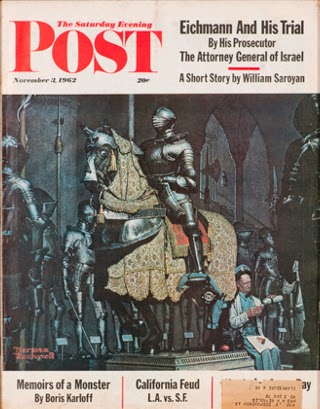
"Lunch Break with a Knight" by Norman Rockwell, 1962


An early clue that I wouldn't survive architecture school came when one of my studio professors scoffed at the skills of populist painter Norman Rockwell.

"That's not art," this particular professor bellowed to us second-year students perched on metal stools beside our white drafting tables.  Rockwell wasn't a good artist, supposedly, because he was too literal.  Good art, according to our professor, should be different things to different people.

Reality is relative, right?

Sure, I thought; sometimes art can be interpreted in multiple ways, and sometimes maybe not.  But do presumptions of the latter mean Rockwell was a bad artist?  Not in my book.

This was one of the many disagreements I had with how my architecture professors wanted their students to view the profession, and our world in general.  Suffice it to say that I never obtained a degree in design.

As far as Norman Rockwell is concerned, however, I'm not sure how anybody can argue that his art isn't compelling.  Take, for example, what's probably my favorite Rockwell work, "Lunch Break with a Knight".  He created it for the November 3, 1962 edition of the Saturday Evening Post, a popular magazine in his day.  And while at first glance, it looks like a literal depiction of a museum security guard having a break in a darkened gallery featuring suits of armor, there's a lot more going on that people like my architecture professor apparently miss.

The setting for this painting is attributed to the former Higgins Armory Museum in Worcester, Massachusetts, whose collection has since been assumed by the Worcester Art Museum.  But we don't really need to know the setting from which this tableau has been adapted to understand that body armor has had a long and colorful history.  And that the best armor was usually worn by the most powerful warriors.  And that masculinity, for all of its pretense of aw-shucks simplicity, can be downright audacious in the gaudy spectacle some men make of themselves.  Just look at all of the shiny metal that was worn into battle after being perforated with intricately-designed embellishments, polished, adorned with plumes, and strapped with leather and fabric.

Oh, the poor horses that had to carry those men, clanking about in iron suits that must have weighed a ton!  And even some of the horses were sheathed in matching metal shields.  Towards the latter part of the Middle Ages, some armies were actually breeding special horses that could remain exceptionally agile under such a burden.

And how majestic these horses and riders must have looked!  How invincible they must have felt!  These were the rock stars of their day; the men for whom damsels swooned, and to whom kings apportioned property.  Heroes, conquerors, with the physical strength to carry all of this armor and be mobile enough to be able to protect themselves.  Wimps like me couldn't possibly hope to find any greater satisfaction wearing such a get-up than standing up and not tipping over.

Eventually, as guns and bullets replaced arrows and swords, armor plating became ineffective.  By the turn of the 18th Century, such armor had become more ceremonial than functional, and was used more by commanders and royalty to monitor battles, than by foot soldiers doing the actual fighting.  By the time of America's Civil War, body armor had become so obsolete, neither the North nor the South provided any to their soldiers, although some desperate men on both sides are reported to have personally bought pieces of body armor for themselves.  Interestingly, across the world in Japan, this was about the same time that body armor had its last gasp for Samurai warriors as well.

But all of that is ancient history, right?  How does Rockwell's painting relate to us today?  After all, good art is supposed to be trans-generational and cross-cultural, right?

Well, let's look at Rockwell's composition for this scene, shall we?  We've got a darkened museum gallery, with one armored horse and rider illuminated in the middle, suggesting that the museum is closed for the day, with at least one spotlight left burning to help the watchman do his job.  We also see this watchman's black, industrial-sized flashlight - there, in the pocket of his jacket, that he's carefully draped over the foot and stirrup of our gallant suit of armor, and the finely clothed horse.

The watchman's cap is tilted back, presumably after he's rubbed his forehead in a relaxing gesture to indicate that all is currently right with his world.  He's got his black metal lunchbox at his side, and he's seated on the display, comfortable and cozy.  His napkin is neatly unfolded into a perfect square on his lap, and - instead of his healthy apple! - he's got a delectable slice of chocolate-frosted cake.  We can almost taste what he's getting ready to enjoy with a steaming cup of coffee from his Thermos!

Okay - so it's a pretty typical depiction of a normal, working man's coffee break.  Which is precisely the juxtaposition Rockwell wants to portray against the backdrop of such armored grandeur.  Imagine the mortal battles through which all of this majestic armor has endured!  How about the mighty men of valor who won wars - or lost their lives - wearing all of this hardware?  Can you hear the noise and chaos of conflict, with clanging swords, stomping horses; the screaming and yelling of strong, muscular men fighting to the death?

Meanwhile, our docile watchman doesn't appear to have a weapon of any kind, unless you count that hefty-looking flashlight.  He's got no gun, or bullet-proof vest, and why should he?  What's in this museum that's worth his life?  Everything is either insured, or so famous that nobody could steal it and hope to sell it on the black market.  This man's presence in this closed, dark museum is more of a deterrent for bumbling vandals or mischievous teenagers than a front line against a desperate aggressor.

And what of all these suits of armor, anyway?  Sure, we see little placards at the feet of every display, where museum officials have provided some information about who might have worn each particular piece, or when it was used.  But who among us would otherwise know that information, or the names of the men who lived and died in these suits?  In their day, they were men of value, importance, intrigue, and prestige.  But today?  We look at their armor and briefly marvel at how primitive warfare used to be.  Today, our state-of-the-art Kevlar and other sophisticated, high-tech fabrics that serve as modern body armor function amazingly well, even if they don't look as grand as these suits of armor.

Indeed, it's the irony between grandeur and humility that embodies Rockwell's message with this painting.  Grandeur of the past, and forgotten names, contrasted with the humility of a night watchman, taking his coffee break, and a brief, relaxing respite at the feet of armor that once stood between life and death for the person wearing it.  And speaking of feet, a full graphic of this painting shows that the watchman is a rather short fellow, seated on the pedestal with his feet dangling up off of the floor.  Not exactly swashbuckling, right?

Okay.  So...  here's where Rockwell's painting hits home.  Four hundred years from now, who's going to remember your name?  How antiquated is what you're wearing right now going to look?  How significant will what you're doing right now for a living have been, even if you're saving some current entity from defeat?

Maybe people who don't think such paintings are art simply don't like what such paintings are saying.


Thursday, July 3, 2014

Independence on Parade


When I was a kid, the little village in which we lived threw a Fourth of July parade.

It was a small parade, with not a lot of excitement, but our humble village in Upstate New York was small and boring, too.  So it kinda fit.

We had a volunteer fire department, and they'd ride their big red trucks through town on the evening of July 4.  Local owners of old cars would line up and drive them through town, too.  And people on the fire trucks and the old cars would throw candy and trinkets to us kids who lined the two short blocks of the parade route.

Beforehand, back at home, Mom and Dad would give us our nightly baths, and then take my brother and me, all squeaky clean in our PJs, down to the village, where we'd sit in the heat and humidity of Central New York's steamy summers, without air conditioning, in those Volkswagen buses my parents used to own.

Our father's mother and sister would usually be up from Brooklyn, taking a break from the chaos of a typical New York City July Fourth, but I can't remember them joining us at our kitschy local parades.  Coming from the big city, they probably didn't think it was worth the bother.

It's an American tradition, isn't it?  The Fourth of July parade.  Here in Arlington, Texas, we have one of the largest such parades in the country, although I don't usually attend.  Julys in Texas are usually beastly hot, even in the mornings, beating anything we had in Upstate New York.  And mornings are when Arlington's annual parade is held, because it's still cooler than the afternoon, or even the evening.  But that's not saying much.

One year, a friend of Mom's was the honorary grand marshal, meaning she got to ride in a vintage convertible at the head of the parade, and she just about suffered heatstroke from the ride.

New York City doesn't have an Independence Day parade, but that may be because practically the entire city succumbs to anarchy when evening comes, and all the illegal fireworks come out.  Honestly, it sounds like the Big Apple is under attack, as bombs passing for pyrotechnics are detonated on any flat surface New Yorkers can find.  It's awful; I simply cannot understand what is enjoyable about it.  One year when I lived there, two people in Brooklyn's Bay Ridge neighborhood were killed when a rocket screeched up into the eaves of their wood-frame home, where it smoldered undetected for a few hours, until it suddenly consumed the roof, which then collapsed.

My favorite Independence Day memories, however, are more recent, and come from coastal Maine, and another Brooklyn.  Only this one is spelled "Brooklin".

Brooklin is about the size of our old village in Upstate New York, and it has a parade, too, consisting of little more than fire trucks from local volunteer fire departments, and locally-sourced antique cars.  But frankly, there are a lot of wealthy summer people "from away" who populate coastal Maine on July 4, and their antique cars are pretty classy, pretty old, and a lot more fun for me to admire now than when I was a kid.

Near Brooklin, at least as the crow flies, is an island called Deer Isle, and one of the villages on that island holds an annual fireworks display that, at least by small-town standards, is fairly respectable.  There's something about fireworks going off above inky-black water that makes them more interesting to me.  Maybe it's the reflection of all the lights and colors on the rippling surface of the water below.

Fourth of July is pretty much a kids' holiday, isn't it?  Like Christmas.  Most of the people launching their earth-shaking pyrotechnics in New York City are kids - or adults acting like kids.  Meanwhile, the official fireworks shows most sensible cities put on every year can bring out the kid in a lot of adult spectators.  Even in Brooklin today, candy and trinkets are tossed to the children lining the village's two-block parade route.

Ironically, though, driving through Deer Isle a few Fourths ago, on our way to a hillside viewing position for the fireworks show, my brother pointed out a newly-remodeled home owned by summer people from away.  And you can tell the difference between homes owned by summer people and those owned by native, local Mainers.  This home's lawn was covered by rented folding chairs and tables with white tablecloths, while tuxedoed caterers set out platters of food amongst candlelit hurricane globes for some fancy al fresco Fourth feast.  Within view of the fireworks, of course.

Leave it to the one percenters to make their guests dress for dinner on Independence Day!  In rural Maine, no less.  While the rest of us dine on barbecued hot dogs and hamburgers in our shorts and flip-flops.  And sweaty kids drizzle melted ice cream down their chins.

Ahh, yes.  To each his own on Independence Day, right?